

Get preapproved by a lender before you set foot on a dealer lot. If your credit reports show errors or your utilization is high, spend one to two weeks fixing what you can first, since even a modest score jump can change your rate. Either way, pull your credit reports and gather your income documents today. Preapproval gives you real negotiating leverage compared to relying on a dealer's best guess.
TL;DR:
- Getting preapproval before shopping for a car provides real negotiating power and is more reliable than prequalification, which only offers rough estimates.
- Applying for multiple auto loans within a two-week window counts as a single credit inquiry, preventing unnecessary score dips during rate shopping.
- Prioritize cleaning up credit report errors and reducing debt-to-income ratio before applying to improve approval chances and secure better rates.
- Comparing offers from banks, credit unions, and online lenders is essential, as each has different strengths, with credit unions often offering the lowest APRs.
- Being aware of common denial factors like recent late payments or high existing debt allows buyers to address issues proactively and increase approval likelihood.
Table of Contents
- What's the Difference Between Prequalification and Auto Loan Preapproval?
- How Do You Get Approved for a Car Loan, Step by Step?
- How Does Your Credit Score Affect Your Rate and Approval Odds?
- Where Should You Apply: Banks, Credit Unions, Online Lenders, or Dealers?
- What Do Lenders Check, and Why Do Applications Get Denied?
- What Quick Fixes Actually Improve Your Approval Odds?
- An Editor's Take on Getting Financed the Smart Way
- Pioneer Credit Solution: A Direct Path to Loan-Ready Credit
- Where to Verify Your Rights and Numbers
- Sources
- FAQ
What's the Difference Between Prequalification and Auto Loan Preapproval?
Prequalification uses a soft credit pull, so it doesn't touch your score, and it gives you a rough estimate of what you might borrow. Preapproval is the real thing: a hard inquiry paired with a conditional loan offer that names an actual rate, term, and amount. That difference matters once you're standing in a dealership trying to negotiate price instead of monthly payment.
Use each one at the right moment:
- Prequalify first to compare ballpark offers across several lenders without any score impact.
- Preapprove second, once you've narrowed to two or three lenders you'd actually borrow from.
- Rate-shop within a short window. Credit bureaus typically treat multiple auto loan inquiries made within about two weeks as one shopping event, not a stack of separate hits.
That timing detail alone can save you from an unnecessary score dip.
How Do You Get Approved for a Car Loan, Step by Step?
Auto loan approval follows a predictable sequence, and skipping steps is how buyers end up with worse rates than they deserve.
- Pull your credit reports for free at AnnualCreditReport.com and dispute anything inaccurate before you apply.
- Gather your documents: government ID, recent pay stubs, tax returns or bank statements if you're self-employed, proof of residence, and details on the vehicle you want.
- Prequalify with two or three lenders using soft pulls to see rough terms.
- Apply for preapproval with at least one lender so you walk in with a firm conditional offer.
- Shop for the vehicle, then finalize the loan once you and the dealer agree on price.
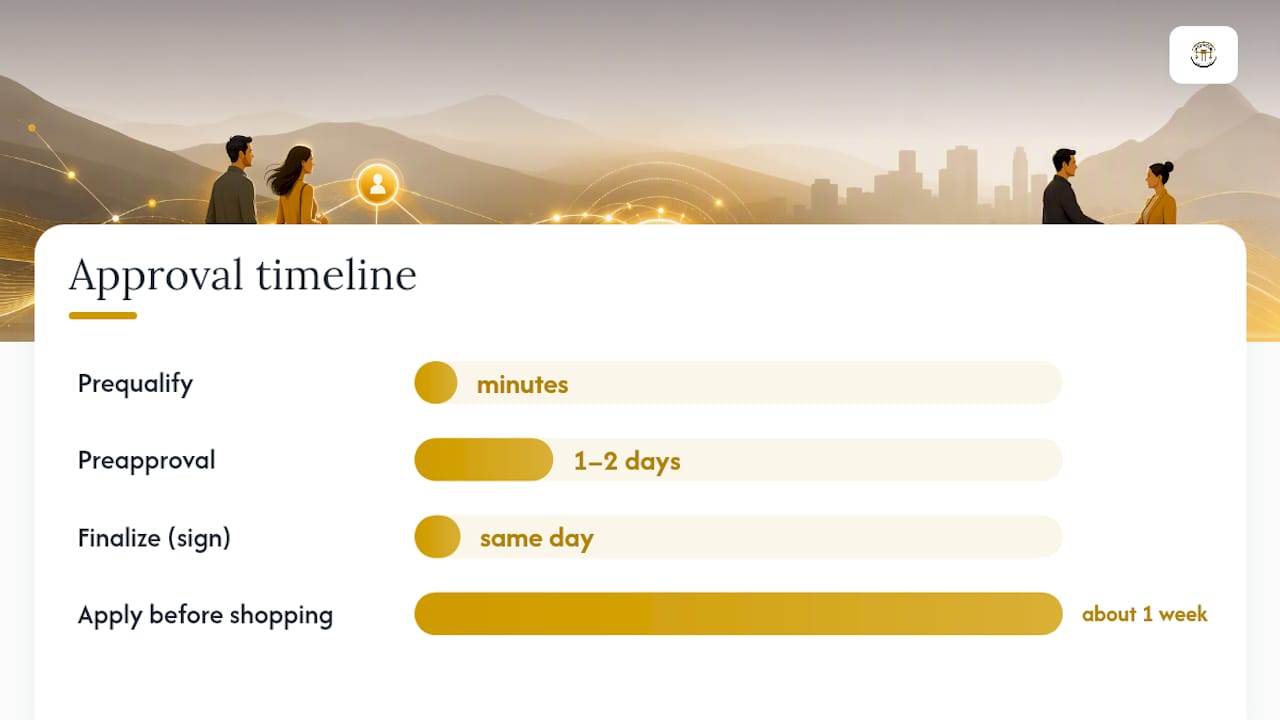
Timelines vary but follow a rhythm: prequalification often takes minutes online, preapproval usually clears in a day or two, and final signing happens the same day you buy once the lender verifies your paperwork against the actual vehicle.
Pro Tip: Apply for preapproval with your bank or credit union about a week before you plan to shop. That gives you a real number to negotiate against instead of guessing at the dealer's finance desk.
How Does Your Credit Score Affect Your Rate and Approval Odds?
Your credit score is the single biggest lever on your interest rate. Borrowers with scores below roughly 660 can often still qualify, but they typically face higher rates and tighter conditions, while prime and super-prime borrowers see meaningfully better pricing on similar vehicles.
Where you land matters more than the vehicle you're buying. A borrower with a strong credit profile and a modest down payment routinely outprices a subprime borrower on an identical car, sometimes by several percentage points on APR.
Lenders weigh more than the score alone:
- Debt-to-income ratio (DTI): most lenders want your total monthly debt, including the new car payment, to stay well under half your gross monthly income.
- Income verification: pay stubs, W-2s, or tax returns confirming steady earnings.
- Down payment and loan-to-value ratio: a larger down payment lowers what you finance relative to the car's worth, which tends to soften both approval risk and pricing.
Where Should You Apply: Banks, Credit Unions, Online Lenders, or Dealers?
Each lender type serves a different kind of buyer, and comparing at least two matters more than picking the "right" one.
- Banks often reward existing customers with rate discounts but can be slower to approve unfamiliar applicants.
- Credit unions frequently post some of the most competitive APRs, especially for members with fair to good credit, though membership requirements apply.
- Online lenders move fast and cast a wide net across credit tiers, which helps buyers who've been turned down elsewhere.
- Dealer financing offers convenience and occasional manufacturer incentives, but the dealer's markup on the rate can quietly inflate your cost.
Compare offers using APR, total finance charge, fees, and loan term side by side, not just the monthly payment. Get at least two preapprovals from different lender categories before you commit; it's the single easiest way to confirm you're not overpaying.
What Do Lenders Check, and Why Do Applications Get Denied?
Underwriters look at a specific set of factors, and knowing them ahead of time lets you fix problems before a lender finds them.
- Credit history and recent delinquencies, especially anything in the last 12 to 24 months.
- Employment and income verification, confirming your pay is stable and sufficient.
- Debt-to-income ratio, since high existing debt can sink an otherwise strong application.
- Vehicle valuation, because lenders won't finance more than a car is realistically worth.
Common denial triggers include a thin credit file, a recent late payment, an unverifiable income source, or a car priced above the lender's loan-to-value comfort zone. If you're denied, ask the lender directly for the reason, a right guaranteed under federal lending law, and if something looks wrong, you can dispute it or file a complaint with the Consumer Financial Protection Bureau.
What Quick Fixes Actually Improve Your Approval Odds?
Some fixes move fast. Others take a coordinated strategy.
- Dispute credit report errors immediately; incorrect late payments or duplicate accounts can quietly cost you points.
- Lower your credit utilization by paying down revolving balances before applying.
- Strengthen your documentation: a recent pay stub and a clear proof of residence remove friction during underwriting.
- Increase your down payment if you can, since it directly improves your loan-to-value ratio.
- Add a co-signer if your credit file is thin or your score is borderline. A co-signer can materially improve approval odds, but both of you carry equal legal responsibility for the debt if payments stop.
Some of these you can handle in a weekend. Others, like removing inaccurate collections or negotiating with creditors, take longer and benefit from professional guidance. Credit repair work typically runs weeks to a few months depending on how many negative items are involved, and results vary by credit profile.
Pro Tip: Before you apply anywhere, request your free reports and scan every account for accuracy. A single wrongly reported late payment can be the difference between a prime rate and a subprime one.

An Editor's Take on Getting Financed the Smart Way
The buyers who get burned aren't the ones with bad credit. They're the ones who walk into a dealership with no preapproval and let the finance desk set the terms. Preapproval isn't a formality, it's leverage, and it's the single best defense against spot-delivery tricks where a "done deal" gets renegotiated days later.
If you take one priority from this, make it sequencing: documents first, preapproval second, then shop conservatively within what you can actually afford.
— Danny
Pioneer Credit Solution: A Direct Path to Loan-Ready Credit
If your credit reports are holding your approval odds back, fixing them yourself can eat months you don't have before a car purchase. Pioneer Credit Solution builds a personalized plan using SmartCredit technology to identify and challenge negative items dragging down your score, and many clients report increases of over 120 points during the process.

Beyond credit repair, Pioneer Credit Solution offers credit score boosting and direct auto loan assistance for readers ready to move from repair to financing. Over 10,000 clients have worked with the team to get loan-ready for homes, cars, and businesses. If your file needs work before a lender will approve you at a fair rate, start with a free consultation and get a clear plan for what your credit needs before you apply.
Where to Verify Your Rights and Numbers
Confirm any figure or process in this guide directly against the source before you rely on it:
- The CFPB's auto loan guide walks through required disclosures like APR and finance charge, plus the full preapproval process.
- Bankrate and NerdWallet both track how credit scores translate into real APR ranges.
- AnnualCreditReport.com is the only site authorized to give you free reports from all three bureaus.
This article is general information, not a substitute for advice from a qualified financial advisor. Consult a qualified financial professional about your own circumstances before acting on anything here.
Sources
- Take control of your auto loan: A step-by-step guide | CFPB
- Advantages of getting pre-approved for a car loan | NerdWallet
- What credit score do you need to buy a car? | Bankrate
FAQ
Is Getting Preapproved for a Car Loan Legit?
Yes. Preapproval is a standard, federally regulated process where a lender runs a hard credit inquiry and issues a conditional loan offer under Truth in Lending Act disclosure rules. It's not a scam or a gimmick; it's the same underwriting process banks, credit unions, and online lenders use for every applicant, detailed step by step in the CFPB's auto loan guide.
How Much Car Can I Afford on a $70,000 Salary?
There's no single fixed number, since affordability depends on your existing debt, down payment, and the loan term you choose. A common guideline is keeping your total monthly debt, including the car payment, well under half your gross monthly income, so run your actual numbers against your specific expenses before setting a budget.
What Credit Score Do I Need for a $30,000 Car Loan?
Loan size doesn't require a specific score threshold; approval and rate depend more on your overall credit profile, income, and down payment than the price tag alone. Borrowers with scores under about 660 can often still qualify but should expect higher rates and stricter terms, while stronger credit typically unlocks better pricing on the same amount.
What Percentage of Americans Have an Auto Loan?
Specific national figures fluctuate, and this article doesn't have a sourced current percentage to cite. What's consistent is that auto loans remain one of the most common forms of consumer debt in the U.S., and lenders across banks, credit unions, and online platforms actively compete for creditworthy borrowers.
Does Pioneer Credit Solution Help With Auto Loan Approval?
Yes. Pioneer Credit Solution offers credit repair and auto loan assistance aimed at improving your credit profile before you apply, using SmartCredit technology to target negative items. Current pricing details are available through a free consultation on the site.