
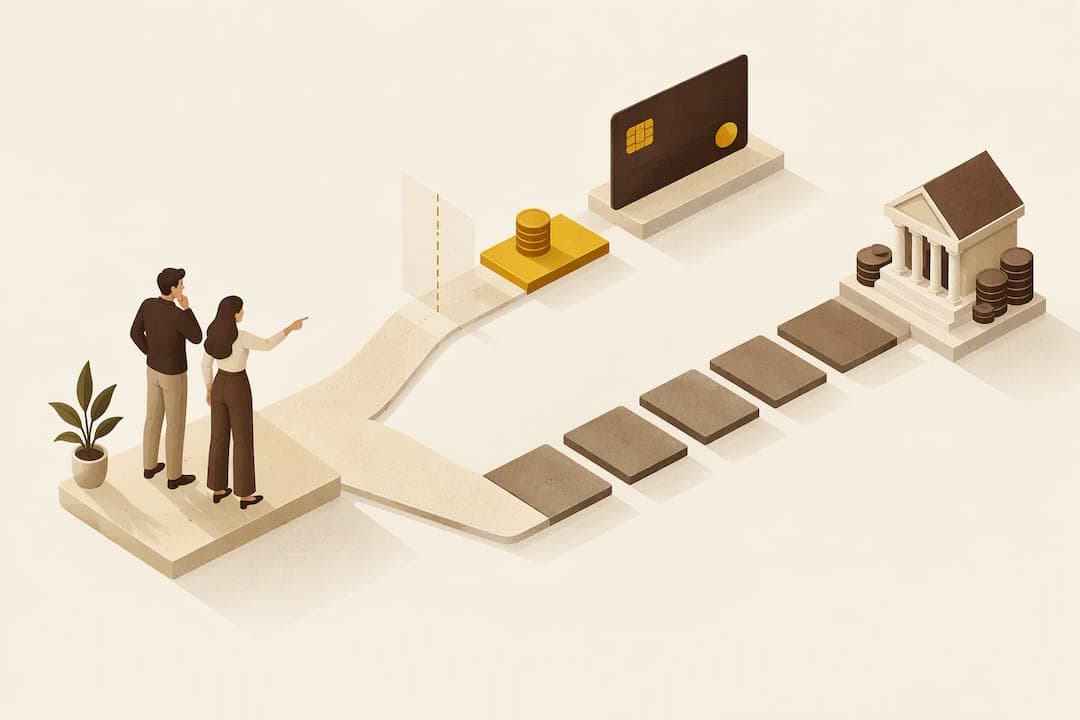
If you need predictable fixed payments or a longer runway to pay down debt, a personal loan tends to fit better, even if the total interest ends up higher. The right pick depends on your discipline, your timeline, and how the fees stack up.
TL;DR:
- Balance transfer cards can be the cheapest option if you can pay off the entire debt within the promotional period, usually under 18 months.
- Personal loans are better suited for those with multiple years to pay off, offering fixed monthly payments and predictable costs over a longer timeline.
- Transfer fees and the risk of interest after the promo expire make it essential to confirm all terms and ensure timely repayment.
- A personal loan's origination fees and fixed interest rate can increase the total cost if the debt is not paid within a shorter period.
- Improving credit scores first enhances eligibility for better offers, as both options favor borrowers with strong credit profiles.
Table of Contents
- Balance transfer vs personal loan: pros and cons at a glance
- What a balance transfer card is and how the promo period works
- What a personal loan for debt consolidation actually involves
- Comparing the real costs: fees, timelines, and credit impact
- A step-by-step way to choose between a transfer and a loan
- Running the math: an example, transfer vs loan
- Pitfalls that turn a good plan into a costly mistake
- What we prioritize when a client asks us this question
- How Pioneer Credit Solution helps you qualify for the better option
- Where to verify the details before you apply
- Sources
- FAQ
Balance transfer vs personal loan: pros and cons at a glance
Both tools solve the same problem, high-interest credit card debt, but they get you there in different ways. A balance transfer card moves your existing balance to a new card, often with a 0% introductory rate for a set period. A personal loan gives you a lump sum with a fixed rate and a fixed monthly payment for the life of the loan.
- Balance transfer cards offer 0% promotional periods but usually charge a transfer fee, often a percentage of the amount moved, and the rate jumps once the promo ends.
- Personal loans carry a fixed APR and a fixed term, so your payment never changes, but many include origination fees that add to the total cost.
- Fast payers who can clear the balance in a year or two generally do better with a transfer card.
- Borrowers who need three to five years to pay off debt, or who want payment certainty, usually do better with a loan.
Neither option fixes the habits that created the debt. Both work best when paired with a real payoff plan.
What a balance transfer card is and how the promo period works
The catch is the balance transfer fee. Card issuers are allowed to charge this fee even when the promotional rate is 0%, and it's usually rolled into the balance you're paying off, so you start slightly behind.
Payments get applied in a specific order, and this matters more than most people realize. Some cards strip the grace period on new purchases entirely once you've done a transfer, so interest can start accruing the day you swipe. A sample cardmember agreement from Discover shows how a 3% transfer fee and daily interest calculations work in practice, and every issuer structures these details slightly differently.
Once the promo period ends, whatever balance remains starts accruing interest at the card's standard rate, which can be considerably higher than what you'd pay on a personal loan. If you haven't paid off the balance by then, the math that made the transfer attractive can flip against you fast. Reading the card's actual terms, not just the marketing headline, is the only way to know what you're really signing up for.

What a personal loan for debt consolidation actually involves
A personal installment loan gives you a lump sum, usually deposited directly or sent to your creditors, that you repay in fixed monthly installments over a set term, commonly two to seven years. The interest rate is fixed at the time you sign, so your payment stays the same from the first month to the last. That predictability is the loan's biggest selling point.

Most personal loans come with fees, and the CFPB notes that consumers should check lender disclosures carefully to see what's included. Origination fees are common and are often deducted from the loan proceeds before you ever see the money, which means the amount that actually lands in your account can be lower than the amount you're borrowing. Late fees and prepayment penalties vary by lender, so it pays to compare more than one offer.
On your credit report, a personal loan shows up as an installment account rather than revolving credit. That distinction affects your credit mix, one of the factors scoring models weigh, and it doesn't count against your credit utilization the way a maxed-out card does. Applying for the loan does trigger a hard inquiry, and opening a new account can temporarily lower your average account age. For many people juggling multiple high-balance cards, trading revolving debt for a fixed installment loan improves the utilization side of their score even as it adds a new account.
Comparing the real costs: fees, timelines, and credit impact
The sticker numbers on a balance transfer offer or a loan quote rarely tell the whole story. You need to run both options through the same lens: total cost over the time you'll actually need to pay off the debt.
Start with the balance transfer fee. If a card charges 3% on a transferred amount and offers 18 months at 0%, you're paying that fee upfront in exchange for over a year of interest-free payments, a structure the CFPB confirms applies even to 0% offers. Compare that fee against a loan's origination fee plus the interest you'd pay over the loan's fixed APR and term. The transfer usually wins on pure cost if you can retire the balance before the promo ends. It usually loses if any balance rolls over into the card's standard rate afterward.
Timeline changes everything. A promo period is short by design, often under two years, which forces discipline. A loan term can stretch to five years or more, lowering your monthly payment but increasing the total interest you pay over the life of the loan. A lower payment feels easier today and costs more over time.
Credit score mechanics differ too. A transfer shifts your utilization from one card to another without adding a new type of account, so if you keep the old card open with a zero balance, your utilization can improve and your available credit mix stays revolving-heavy. A personal loan diversifies your mix into installment credit and can lower utilization more decisively if it pays off multiple cards at once, but it adds a hard inquiry and a new account to your file.
Flexibility and behavior are where good plans fall apart. New purchases on a transferred card can quietly erase your progress. A missed payment on either product can trigger penalty rates or late fees. And a loan, once funded, is fixed. You can't renegotiate the term without refinancing.
- Add up total cost first: transfer fee plus any post-promo interest risk, versus loan origination fee plus full-term interest.
- Match the timeline to your discipline: short, aggressive payoff favors a transfer; steady, predictable payments favor a loan.
- Check your credit mix: a loan adds installment debt, a transfer keeps things revolving.
- Watch for behavioral risk: new charges on a transferred card, or a missed loan payment, can undo the savings either option offers.
Pro Tip: Before applying for either product, pull your latest statements and list every balance, rate, and fee side by side. You can't compare total cost accurately until you see all the numbers in one place.

A step-by-step way to choose between a transfer and a loan
Working through the decision in order keeps you from fixating on the most attractive number and missing a costlier detail buried in the fine print.
- Gather your current balances, APRs, and any promotional terms you've already been offered, including transfer fees and loan APRs quoted by lenders.
- Estimate how fast you can realistically pay off the balance. If you can clear it within a card's promo window without adding new charges, a transfer likely saves more money.
- Run the total-cost comparison: add the transfer fee to any expected interest after the promo ends, then compare that number against the loan's origination fee plus total interest over its full term.
- Check your credit profile and eligibility for each product. The best 0% offers and the lowest loan APRs both go to borrowers with strong scores, so if your score is holding you back, addressing credit issues before you apply can open better terms on either option.
If your balance is small enough to clear in a year and you trust yourself to avoid new charges, lean toward the transfer. If you're consolidating a larger balance across several cards and want one predictable payment for the next few years, lean toward the loan.
Running the math: an example, transfer vs loan
Numbers make this decision concrete.
- Balance transfer fee: often a percentage of the transferred balance, added to your new balance.
- Monthly payment to clear it in the promo window: calculated by dividing the total balance plus fees by the promo months, with $0 in interest if paid off before the promo ends.
- If any balance remains after 18 months, it starts accruing interest at the card's standard rate, which can add hundreds of dollars quickly.
- Personal loan over 36 months: a fixed monthly payment covers principal plus interest for three years, which lowers the monthly amount but means you're paying interest the entire time, not zero interest for a defined window.
The pattern holds regardless of the exact numbers on your own offers. Paying off a transfer within its promo window is almost always cheaper than a loan on the same balance, because you're avoiding interest entirely rather than paying a fixed rate for years. Stretch the payoff past the promo, or take a shorter loan term with an aggressive payment, and the gap narrows or reverses. Before committing to either, list your specific transfer fee, promo length, loan APR, origination fee, and proposed monthly payment side by side, then do the arithmetic for your own numbers rather than relying on someone else's example.
Pitfalls that turn a good plan into a costly mistake
The most expensive mistakes in debt consolidation come from missed details rather than bad math.
- Promotional-expiry risk: if you don't clear the transferred balance before the 0% window closes, the remaining amount starts accruing interest at the card's standard, often much higher, rate.
- Deferred-interest confusion: some promotional offers charge back interest from day one if you don't pay in full by the deadline, so the CFPB advises reading disclosures carefully before assuming a 0% offer is risk-free.
- Skipping the free option first: calling your creditor directly to ask for a lower rate or a payment plan costs nothing and sometimes works before you ever need a transfer or loan.
Confirm every fee in writing, call your card issuer or lender to verify terms before you apply, and check the CFPB and FTC directly if an offer sounds too good to be true.
What we prioritize when a client asks us this question
When a client asks whether to transfer a balance or take out a loan, we start with the same three questions every time: what will this actually cost over the full payoff period, does your current score even qualify you for the best offers available, and can you realistically stick to the timeline either option requires. A transfer that expires before the balance is cleared, or a loan approved at a mediocre rate because of a thin credit file, often costs more than the "expensive" option everyone assumed was worse.
We recommend working on credit repair or score boosting first when a client's profile is the real obstacle, not the math. If qualifying is the barrier, that's the problem worth solving before signing anything.
— Danny
How Pioneer Credit Solution helps you qualify for the better option
Neither a balance transfer nor a personal loan does you much good if your credit profile keeps you from qualifying for a decent rate. That's the gap we work on every day. Pioneer Credit Solution combines credit repair services with hands-on score boosting and access to lenders, so you're not stuck choosing between two offers that both cost more than they should.

If you'd rather skip the transfer route altogether and consolidate through a fixed, predictable loan, we help match clients with personal loan options suited to their situation, including debt consolidation loans nationwide for those juggling multiple balances. Business owners weighing similar consolidation decisions for company debt can also explore our business loan options.
- Low score blocking a 0% offer or a competitive loan rate: credit repair addresses the negative items dragging your score down.
- High utilization across several cards: score boosting and structured payoff plans lower utilization ahead of a new application.
- Need help comparing loan offers: our team can help match you with lenders suited to your credit profile and goals.
Get a free consultation through Pioneer Credit Solution's services page to find out where your credit stands before you apply for either product.
Where to verify the details before you apply
Card and loan terms change, and the fine print matters more than any general rule of thumb. These are the primary sources worth checking directly.
- CFPB: consolidating credit card debt covers fees, promotional terms, and what to check before you consolidate.
- IRS Publication 4681 explains when forgiven or canceled debt counts as taxable income.
- FTC guidance on debt relief explains your rights and how to spot upfront-fee scams.
- FDIC consumer resources on refinancing cover the credit impact of closing old accounts, and for those exploring hardship arrangements beyond a transfer or loan, Bfil outlines alternative repayment structures.
Sources
- CFPB — What do I need to know about consolidating my credit card debt?
- CFPB — What is a balance transfer fee? Can a balance transfer fee be charged on a 0% offer?
- IRS — Publication 4681: Canceled Debts, Foreclosures, Repossessions, and Abandonments
- CFPB — Do personal installment loans have fees?
FAQ
Is it better to do a balance transfer or get a loan?
A personal loan tends to work better if you need a longer repayment timeline or a fixed payment you can count on for years, even though it typically carries more total interest.
How do I get rid of a large amount of credit card debt?
Start by listing every balance, rate, and minimum payment, then decide whether a balance transfer or a personal loan fits your timeline and credit profile better. For debt spread across several cards, a consolidation loan can combine everything into one fixed payment, while calling creditors directly to negotiate a lower rate is a free step worth trying first.
Is a balance transfer the same as a personal loan?
No. They solve the same problem through different mechanics, revolving credit versus installment credit.
Is there a downside to balance transfers?
Yes. Most cards charge a balance transfer fee even on 0% offers, and any balance left after the promo ends starts accruing interest at the card's standard rate, which can erase the savings if you don't pay it off in time.