
Yes, you can refinance a car loan with bad credit, but approval and pricing depend far more on your loan-to-value ratio, debt-to-income ratio, and payment history than on the score itself. Refinancing can lower your monthly payment, though stretching the term often means paying more interest over time. Before you apply anywhere, confirm your current payoff amount, pull your credit reports, and request soft-pull prequalification quotes from two or three lenders so you know where you stand.
TL;DR:
- Refinancing with bad credit depends more on your loan-to-value ratio, debt-to-income ratio, and payment history than on your credit score alone.
- Lowering your vehicle's LTV below 80 percent or paying down key debts can significantly improve your refinance chances and offer better rates.
- Using a cosigner with strong credit or making a larger down payment can offset your low credit score and increase approval likelihood.
- Starting with soft pull prequalification and verifying lender legitimacy helps avoid wasted inquiries and scams.
- Repair your credit report errors or negative marks before applying if they are recent or disputable, as this can lead to better refinancing terms.
Table of Contents
- What Lenders Look At Beyond Your Credit Score
- Where To Look When Your Credit Is Poor
- How To Prepare Before You Apply
- Comparing Offers: What The Numbers Actually Tell You
- When Refinancing Can Backfire
- What Refinancing With Bad Credit Actually Costs
- How Long The Refinance Process Actually Takes
- Documents You'll Need And What Each Step Does To Your Score
- Should You Fix Your Credit First Or Refinance Now?
- A Faster Path To Better Loan Terms, Not Just A Refinance Application
- Where To Verify Lenders And Rates
- Sources
- FAQ
What Lenders Look At Beyond Your Credit Score
Your credit score opens or closes doors, but it's rarely the whole story once a lender starts underwriting your file. For borrowers refinancing with poor credit, four other factors often carry as much or more weight, and they're all things you can influence before you ever submit an application.
Loan-to-value ratio (LTV) measures how much you owe against what the car is actually worth. An LTV under 100% meaningfully improves your refinance odds, and dropping below roughly 80% often unlocks noticeably better offers, according to Bankrate. Lenders treat high LTV as the riskiest part of a bad-credit file, since it means they'd recover less than the loan balance if you defaulted. Pay down principal or add a down payment at refinance and you shrink that risk directly, sometimes enough to offset a weak credit score entirely.
Debt-to-income ratio (DTI) is your total monthly debt payments divided by your gross monthly income. Add up your rent or mortgage, credit cards, student loans, and the car payment itself, then divide by what you earn before taxes.
Payment history on your current auto loan matters more than almost anything else in your file. Twelve months of on-time payments, even with a low score, signals to underwriters that you're a reliable borrower who happened to have credit trouble elsewhere.
Vehicle criteria also factor in. Lenders typically set caps on:
- Vehicle age (often 10 years or newer)
- Mileage (commonly under 100,000 to 125,000 miles)
- Clean title status, with no salvage or rebuilt brands
- Minimum loan balance, since many lenders won't refinance small remaining balances
Underwriting guides from Debt consistently list LTV, DTI, payment history, and vehicle age among the primary factors weighed alongside credit score. Two more levers deserve attention: a cosigner with strong credit and a larger down payment. Both directly offset the risk a lender associates with a low score, and both are things you control right now, not something you have to wait months to improve.
Where To Look When Your Credit Is Poor
Not every lender treats bad-credit refinance applicants the same way, and knowing where to start saves you from wasted hard inquiries and false hope.
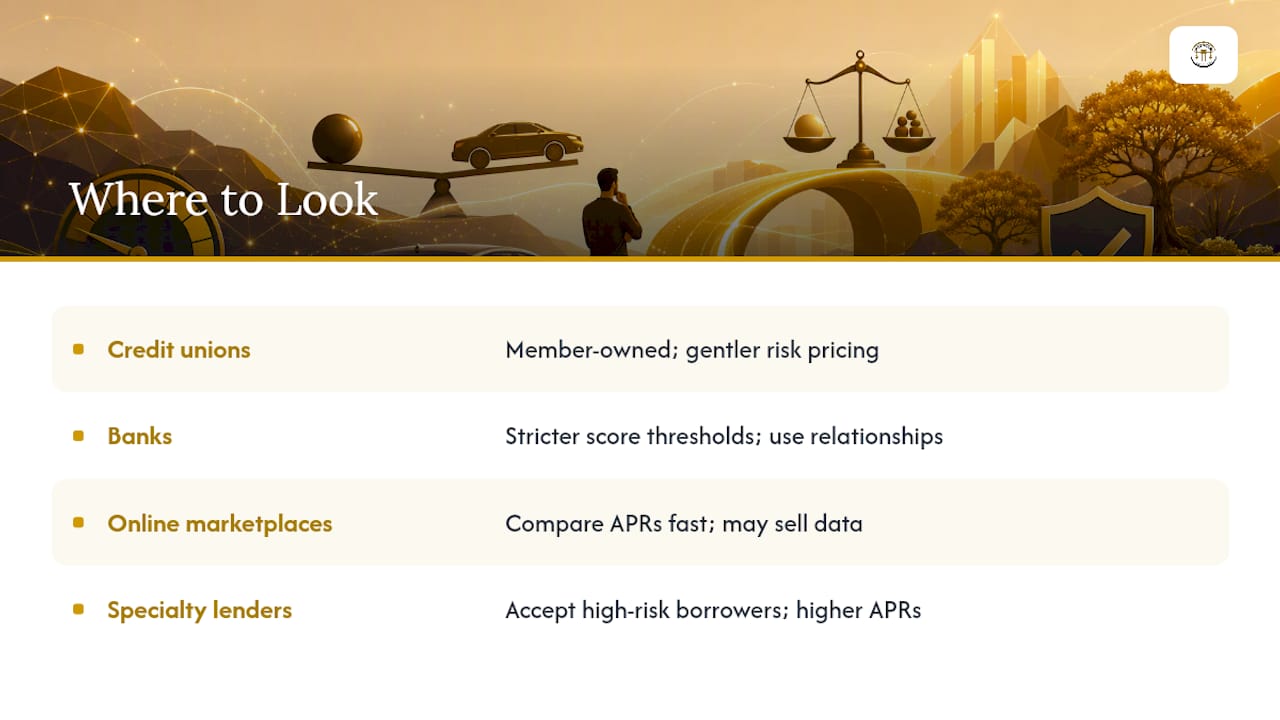
Credit unions tend to produce the best outcomes for borrowers who qualify for membership. Because they're member-owned and not chasing shareholder returns, they often price risk more generously than banks or specialty lenders, an advantage Debt.org points to directly for bad-credit refinance shoppers. Membership eligibility usually hinges on where you live, work, or worship, or whether a family member already belongs. Check the National Credit Union Administration's consumer tools to confirm a credit union is federally insured before you apply.
Banks work best for borrowers whose credit has recently improved or who already bank there and have a relationship to leverage. Trade-off: banks are often stricter on minimum score thresholds than credit unions or online lenders.
Online marketplaces and broker platforms aggregate offers from multiple lenders through a single application, which is efficient for comparing APRs quickly without applying separately everywhere. The trade-off is that some of these platforms sell your information to multiple lenders at once, generating a wave of calls and inquiries.
Specialty bad-credit lenders exist specifically for borrowers that traditional banks decline. They can be useful when your options elsewhere have dried up, but they usually charge meaningfully higher APRs and sometimes tack on origination fees that eat into any savings.
Pro Tip: Before signing anything, search the lender's name plus "complaints" and check them against the NMLS Consumer Access database and your state's Better Business Bureau listing. A legitimate lender will have a licensable, searchable record.
Watch for red flags at every stage: pressure to sign the same day, refusal to disclose the APR upfront, requests for payment via gift card or wire transfer, and contracts with prepayment penalties buried in fine print. Legitimate lenders don't need to rush you.
How To Prepare Before You Apply
Improving your approval odds is mostly a matter of sequence. Do these in order, and you'll walk into any application with real leverage instead of hoping for the best.
- Pull your credit reports from all three bureaus and read them line by line. Report errors are common enough that disputing inaccuracies can genuinely move your score before you apply, a step Experian recommends as a first move for anyone preparing to refinance.
- Dispute anything wrong. Late payments that were actually on time, accounts that aren't yours, or balances reported incorrectly are all worth challenging directly with the bureau. Corrections can take 30 to 45 days to process, so start early.
- Calculate your current LTV. Divide your remaining loan balance by the car's current market value (check a source like Kelley Blue Book). If you're above 100%, consider paying down principal or bringing cash to the refinance to cross that threshold.
- Target your highest-impact debts. If your DTI is borderline, paying off a small credit card balance or closing a low-limit account you don't use can shift the ratio enough to matter.
- Talk to a potential cosigner early, and be honest about what you're asking. A cosigner with strong credit remains one of the most effective ways to improve approval odds and lower your rate, according to Money, but that person becomes fully liable for the loan if you miss payments. Walk them through the numbers before they agree, and read our guide on using a cosigner with bad credit for what to discuss before anyone signs.
- Prequalify with several lenders using soft pulls. This step preserves your score while showing you the real range of APRs available for your specific profile, a practice Experian recommends before submitting any formal application. Only move to a full application, which triggers a hard inquiry, once you've picked your top one or two offers.
Comparing Offers: What The Numbers Actually Tell You
The advertised interest rate is not the number that matters. APR wraps the interest rate together with fees, so it reflects the true annual cost of the loan, and it's the only figure you should use to compare offers side by side.
Rate gaps by credit tier are steep. Borrowers with scores below 500 have seen average new-car rates near 16%, compared with roughly 9.6% for the 600 to 660 band, according to rate data compiled by Debt.org. That gap alone can mean a difference of thousands of dollars over a five-year loan.
When evaluating any offer, check for:
- Origination fees or application fees added to the loan balance
- Prepayment penalties that charge you for paying off early
- The new term length compared with your remaining term
- Total interest paid over the full term, not just the monthly payment
A simple decision rule: if a new offer lowers your monthly payment but extends your term by two or more years, run the total interest cost before accepting. The goal should generally be either a lower payment without stretching the term significantly, or a shorter term that cuts total interest, rarely both at once, a trade-off Money.com points out clearly for bad-credit borrowers weighing their options.
When Refinancing Can Backfire
Refinancing isn't automatically the right move just because you qualify. If you're within a year of paying off your current loan, the fees and reset amortization schedule on a new loan rarely produce real savings.
Longer terms are the biggest hidden cost. Extending from 48 to 72 months might cut your payment by $100 a month, but it can add well over $1,000 in total interest, especially at bad-credit rates.
Watch for these warning signs before you sign anything:
- Contracts with vague or undisclosed APR figures
- Mandatory add-on products (extended warranties, GAP insurance) bundled without a clear opt-out
- Prepayment penalties on the new loan
- Lenders who discourage you from reading the full contract before signing
If refinancing doesn't pencil out, ask your current lender about a hardship modification, consider selling or trading down to a less expensive vehicle, or spend a few months on a credit-repair plan before revisiting the refinance.
What Refinancing With Bad Credit Actually Costs
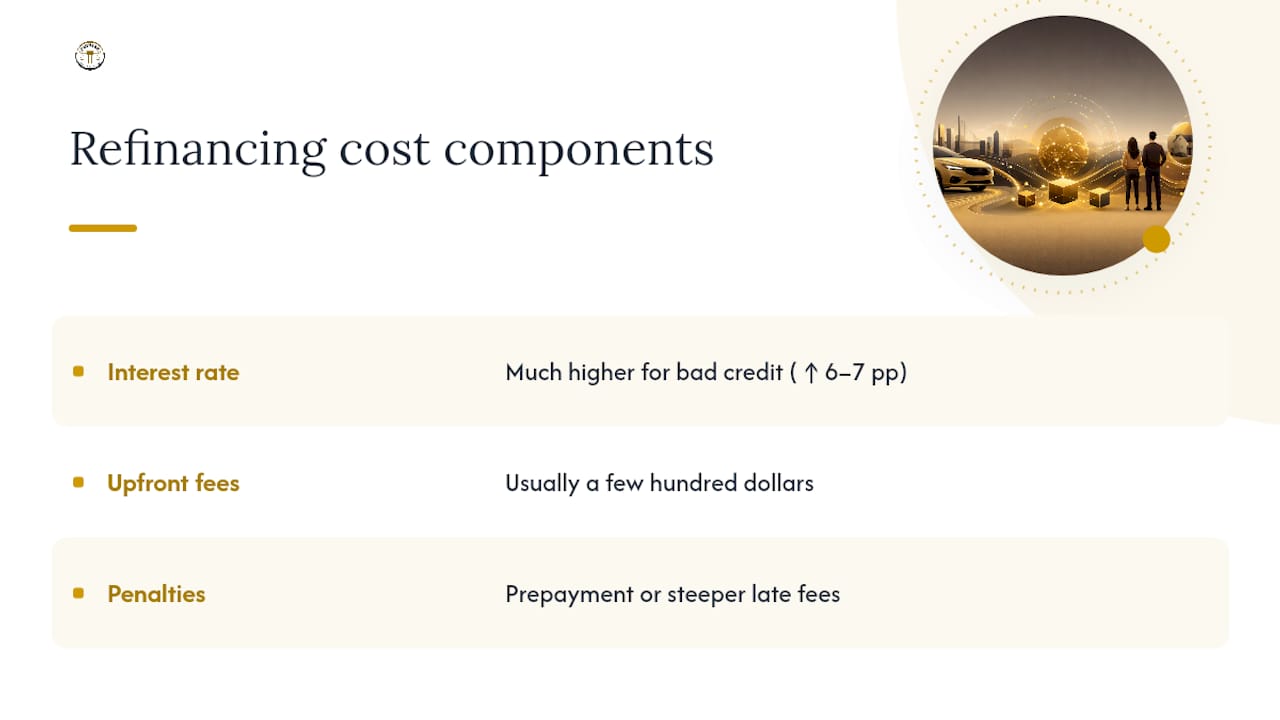
Total cost breaks down into three pieces: the interest rate itself, upfront fees, and any penalties buried in either the old or new loan.
Interest rates for bad-credit refinance borrowers run substantially higher than prime rates, sometimes by six to seven percentage points depending on your score band, as shown in the rate comparisons from Debt.org. That's the single biggest cost driver, and it's why comparing APR across multiple lenders matters more than almost anything else in this process.
Upfront fees vary by lender but typically include an origination fee (often a flat amount or a small percentage of the loan), a title transfer fee charged by your state's DMV, and sometimes a lien recording fee. These are usually a few hundred dollars combined, not thousands, but they should be disclosed clearly before you sign.
Penalties are the wildcard. Some lenders build prepayment penalties into bad-credit loans specifically because they expect to profit from a longer repayment window. Others charge late fees that are steeper than what you're used to. Read the payment schedule and default terms before committing, and ask directly whether the loan carries a prepayment penalty. If a lender hesitates to answer plainly, that's information in itself.
How Long The Refinance Process Actually Takes
Most bad-credit auto refinances move faster than people expect, largely because the vehicle itself already exists as collateral and doesn't require an appraisal the way a home refinance does.
Prequalification typically takes minutes to a day, since it relies on a soft credit pull and basic income and vehicle information. Once you've chosen a lender and submitted a full application, expect a decision within one to three business days for most credit unions and online lenders, though some banks take a week if they require manual underwriting review.
After approval, the lender pays off your existing loan directly, a process that usually takes another three to seven business days depending on how quickly your current lender processes the payoff request. Title transfer paperwork, handled through your state's DMV, can add another one to two weeks in states with slower processing, though this doesn't typically delay your new loan's start date. Altogether, most borrowers go from application to a fully funded refinance in one to three weeks, assuming documentation is complete and there are no title complications.
Documents You'll Need And What Each Step Does To Your Score
Lenders generally ask for the same core documents regardless of credit tier: proof of income (pay stubs or tax returns), proof of residence, your driver's license, your current loan payoff statement, and your vehicle's title or registration.
Prequalification uses a soft credit pull, which has no effect on your score no matter how many lenders you check with. This is why shopping around at the prequalification stage costs you nothing but time. Once you accept an offer and submit a full application, the lender runs a hard inquiry, which can shave a few points off your score temporarily.
If you shop within a focused window, typically 14 to 45 days depending on the scoring model, multiple hard inquiries for the same type of loan are usually counted as a single inquiry for scoring purposes. That's your practical timeline: get your soft-pull quotes first, compare them side by side, then apply formally to your top choice or two within that same short window rather than spreading applications out over months.
Should You Fix Your Credit First Or Refinance Now?
Refinancing right away makes sense if you have strong equity, a clean recent payment record, or a cosigner ready to help, since those factors can outweigh a low score entirely. If your file is thinner than that, a focused three to six month push to repair your credit often produces meaningfully better rates than rushing into a refinance today.
This guidance comes from Danny, whose background in credit repair and financial consulting shapes a borrower-first view: chasing the fastest refinance isn't always the cheapest path. Many clients who address correctable negative items before applying see improved approval odds and pricing once they do refinance. If your report has disputable errors or short-term dings you're close to aging out of, patience is often the better financial move than a rushed application today.
— Danny
A Faster Path To Better Loan Terms, Not Just A Refinance Application
If your credit report has errors dragging down your score, or you're carrying negative items that are close to falling off, fixing them first can put you in a stronger position than refinancing today ever would. A credit repair service can review your credit report, dispute inaccurate or outdated items on your behalf, and track your progress using credit monitoring tools so you can see real movement instead of guessing.

This route tends to help most if your report contains dispute-worthy errors or short-term negative marks rather than a long history of missed payments, since those are the items most likely to respond to a dispute process. If your file is largely clean and you just need better LTV or a cosigner, refinancing now may already be your fastest option, and that's a fair call to make on your own. But if you're not sure which category you fall into, request a free credit analysis and get a clear read on what's realistically fixable before you apply anywhere.
Where To Verify Lenders And Rates
Before accepting any offer, confirm the lender is legitimate and licensed. The NCUA lets you verify federal credit union insurance status, and NMLS Consumer Access lets you check licensing history and complaints for banks and specialty lenders alike.
Useful places to cross-check rates and lender reputations:
- Debt for underwriting factors and rate benchmarks
- Bankrate's bad-credit refinance breakdown for LTV guidance
- Experian's refinance walkthrough for credit report and dispute steps
- Your state's attorney general or financial regulator page, and the Better Business Bureau, for lender complaint histories
This article is general information, not a substitute for advice from a qualified financial advisor. Consult a qualified financial professional about your own circumstances before acting on anything here.
Sources
- Money
- Debt
- Refinancing a car with bad credit — Bankrate
- How to refinance a car loan with bad credit — Experian
FAQ
Can I refinance my car with a 500 credit score?
Some lenders do refinance loans for borrowers with scores in the 400s and 500s, though rates run considerably higher than for prime borrowers, and strong LTV or a cosigner substantially improves your chances.
Can I refinance my car loan with really bad credit?
Yes, it's often possible, but approval depends more on your loan-to-value ratio, debt-to-income ratio, and payment history than on the score alone, so improving those factors first can widen your options considerably.
What disqualifies you from refinancing a car?
Common disqualifiers include owing significantly more than the car is worth (high LTV), a debt-to-income ratio that's too high, a vehicle that's too old or has too many miles, or a salvage title.
Can I refinance my car loan with a 650 credit score?
Scores in the 600 to 660 band generally qualify for meaningfully better rates than sub-500 tiers, and pairing that with low LTV or a strong recent payment history often unlocks near-prime pricing from credit unions in particular.
Is it worth fixing my credit before refinancing?
If your report has disputable errors or short-term negative items nearing removal, a focused effort to repair your credit first often produces better long-term savings than refinancing immediately.