
For supplier net-terms, lenders and vendors usually check Dun & Bradstreet's PAYDEX first. For bank loans, lines of credit, and most fintech lending, Experian's Intelliscore Plus tends to carry more weight. Equifax Business sits behind both as a third major bureau many banks pull for underwriting. The safest move is always to ask your lender or supplier which report they actually check before you spend a dollar improving the wrong one.
TL;DR:
- Suppliers primarily check Dun & Bradstreet's PAYDEX, which measures payment timeliness based on dollar-weighted trade reports, for granting net-terms.
- Banks and lenders rely more on Experian's Intelliscore Plus and Equifax's bank-performance data when assessing long-term credit risk and loan eligibility.
- Scores from D&B, Experian, and Equifax do not directly align; each uses different data sources and scoring scales, affecting how a business’s credit health appears.
- Improving credit requires monitoring each bureau's file directly and actively disputing errors, with tailored strategies based on the specific reporting agency lenders check.
- Confirm which bureau a future lender or supplier reviews before investing effort, as industries and use cases vary in bureau preferences.
Table of Contents
- D&B vs Experian: What Each Bureau Measures and Why It Matters
- PAYDEX vs Intelliscore vs Equifax: The Numbers That Matter
- What Feeds Each Bureau, and Why the Files Never Match
- Which Lenders and Suppliers Actually Pull Which Bureau
- How to Check, Dispute, and Build Your Business Credit File
- When Professional Help Speeds Things Up
- Update Frequency: Why Your Scores Change on Different Schedules
- Which Industries Lean D&B, and Which Lean Experian
- How Multiple Bureau Reports Change a Lending Decision
- What It Costs to Pull and Monitor Each Bureau
- Stop Guessing Which Score Matters
- Building Business Credit Without Guessing at Bureau Scores
- Where to Verify These Bureau Details Yourself
- Sources
- FAQ
D&B vs Experian: What Each Bureau Measures and Why It Matters
Dun & Bradstreet and Experian Business aren't measuring the same thing, and that's the root of most confusion around "D&B vs Experian." PAYDEX is a dollar-weighted score built almost entirely around payment promptness. A score of 80 means you're paying on time, and because it's dollar-weighted, one large invoice paid 60 days late can drag your PAYDEX down more than a dozen small invoices paid on schedule.
Experian's Intelliscore Plus casts a wider net. It blends payment history with public records, credit utilization, and firmographic data like company age and industry risk. That broader data mix is exactly why banks and leasing companies lean on Experian more than they lean on PAYDEX. A supplier extending net 30 terms mostly cares whether you pay your bills. A bank underwriting a five-year term loan cares about liens, judgments, how much of your available credit you're using, and how long you've been in business. Experian's model was built to answer that second question.
Equifax Business adds a third dimension entirely. Its file leans heavily on Small Business Financial Exchange (SBFE) data, meaning actual loan and credit card performance reported by banks. That makes Equifax especially relevant for bank underwriting decisions where the lender wants to see how you've handled other institutional credit, not just trade accounts with vendors.
Here's how that plays out by use case:
- Supplier and vendor net-terms: D&B/PAYDEX typically drives the decision.
- Bank term loans and business lines of credit: Experian Intelliscore Plus, often alongside Equifax, carries the most weight.
- Equipment leasing: Leasing companies frequently pull Experian for the utilization and public-records picture.
- Business insurance underwriting: Insurers often reference a blend, with Equifax's risk data factoring in when available.
- Vendor vetting by larger companies: Procurement teams frequently check D&B, partly because D-U-N-S numbers are baked into so many corporate vendor systems.
None of this means one bureau is objectively better. It means the "right" bureau depends entirely on who's about to make a decision about your business.
PAYDEX vs Intelliscore vs Equifax: The Numbers That Matter
The three scales don't line up on a single number line, which trips up a lot of business owners comparing reports side by side. Here's how the thresholds actually break down.
PAYDEX runs 1 to 100, and it's the simplest of the three to interpret. A score of 80 or above signals prompt, on-time payment, and most vendors treat 80 as the line between "extend terms freely" and "extend terms cautiously." Scores in the 90s typically mean you're paying early, not just on time.
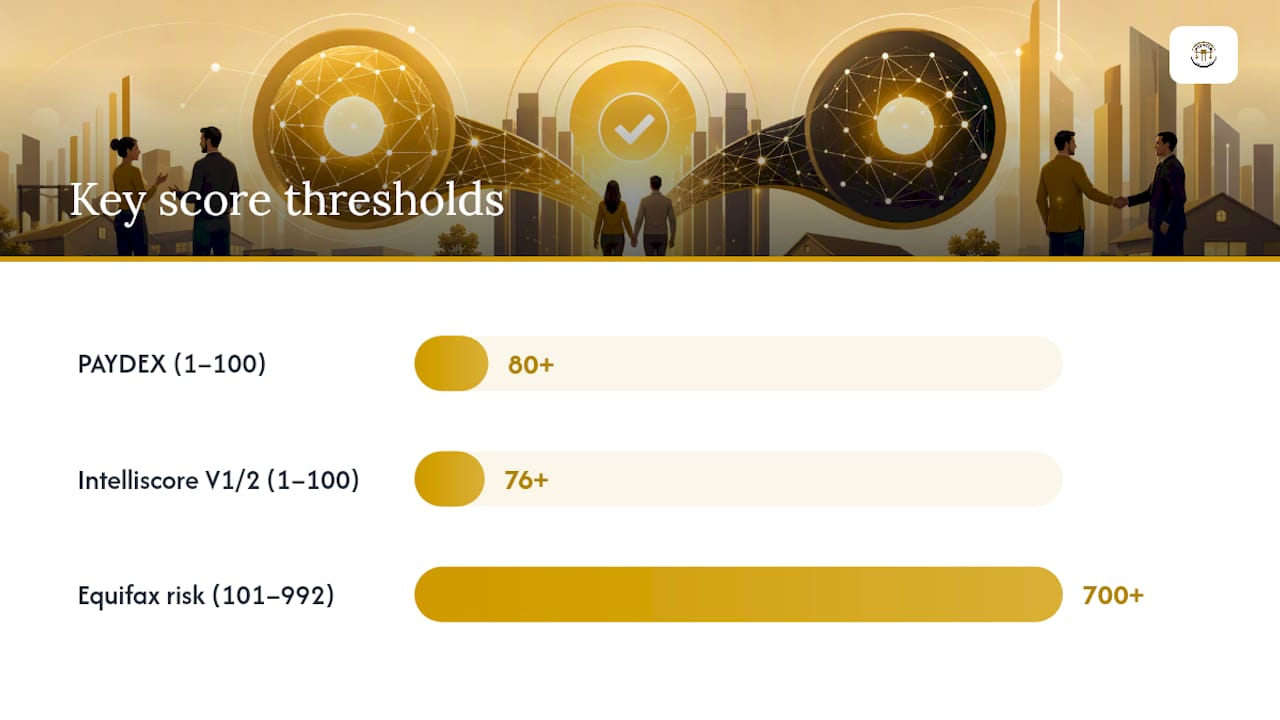
Intelliscore Plus is more complicated because Experian runs two versions. The legacy V1/V2 model uses a 1 to 100 scale, where 76 and above generally lands in the low-risk band lenders want to see. The newer V3 model remaps that to a 300 to 850 style scale, closer to what consumers recognize from personal credit. If a lender mentions a three-digit Experian business score, they're likely looking at V3, not the legacy model.
Equifax's Business Credit Risk Score runs from 101 to 992, with higher numbers indicating lower risk. Equifax also publishes a separate Payment Index on a 0 to 100 scale, mirroring PAYDEX's payment-behavior focus but built from its own data mix. A risk score above roughly 700 tends to signal solid standing to Equifax-reliant lenders, though thresholds shift by lender and industry.
Quick reference: PAYDEX 80+ (on time), Intelliscore Plus 76+ on the legacy scale (low risk), Equifax Business Credit Risk Score 700+ (favorable). None of these numbers translate directly to each other.
What causes different scores to diverge in practice:
- A company with one very large past-due invoice can show a mediocre PAYDEX while still looking solid on Intelliscore, because Experian's model dilutes any single data point across a wider set of factors.
- A newer business with a thin trade history but strong bank account performance might score better on Equifax than on D&B, simply because D&B has fewer trade reports to work with.
- A business carrying high credit card utilization can see Intelliscore Plus dip even while PAYDEX stays strong, since utilization barely touches PAYDEX's dollar-weighted payment math.
What Feeds Each Bureau, and Why the Files Never Match
Business credit files diverge because each bureau collects its raw data differently. Understanding the plumbing behind the score is the fastest way to understand why your D&B file and your Experian file rarely tell the same story.
- Dun & Bradstreet starts with a D-U-N-S number. No D-U-N-S registration, no D&B file, no PAYDEX. Once registered, PAYDEX is built primarily from trade reports submitted by your vendors and suppliers, meaning your score is only as complete as the number of vendors actually reporting your payment history.
- Experian pulls from a broader mix. Its file combines trade line data (sometimes overlapping with the same vendors reporting to D&B), public records like liens, judgments, and UCC filings, and in some cases owner-level information tied to the business.
- Equifax leans on SBFE contributor data, meaning banks and credit card issuers that participate in the Small Business Financial Exchange feed loan and card performance directly into your file. If your business has no bank loans or business credit cards reporting to SBFE, your Equifax file may be thin even if your D&B file looks strong.
The practical takeaway: getting a strong score on one bureau doesn't automatically build a strong file on another. If you want vendor trade lines to count, ask suppliers directly whether they report to D&B, Experian, or both, since not all do both. If you want SBFE data flowing into Equifax, you generally need active bank-issued credit products, not just vendor accounts.
Which Lenders and Suppliers Actually Pull Which Bureau
Matching your effort to the right counterparty saves months of wasted work. Here's the general breakdown business owners run into most often.
- Trade vendors and suppliers offering net-30 or net-60 terms overwhelmingly check D&B, largely because D-U-N-S numbers are so deeply embedded in vendor management and procurement systems.
- Traditional banks issuing term loans or business lines of credit lean toward Experian Intelliscore Plus, and frequently pull Equifax alongside it for the SBFE loan-performance view.
- SBA lenders and larger commercial underwriters have historically relied on a blended SBSS score that incorporated multiple bureaus, but the SBA's move away from a mandatory SBSS pre-screen means lenders now manually review bureau files, and different loan officers may weigh D&B, Experian, and Equifax differently.
- Fintech and online lenders vary widely, some leaning on Experian's API-friendly data, others building their own blended risk models.
The rule that cuts through all of this: ask. Every credible industry explainer on this topic lands on the same advice, that business owners should confirm which specific score a lender or supplier pulls before investing time optimizing the wrong bureau. A five-minute phone call to your loan officer or vendor's credit department can save you weeks of misdirected effort.
How to Check, Dispute, and Build Your Business Credit File
Improving your standing across all three bureaus starts with actually seeing what's in each file, then acting on what you find.
- Register for a D-U-N-S number if you haven't already, then request your D&B report directly. D&B also offers CreditSignal, a free monitoring tool that alerts you to changes in your file, which is worth activating even if you're not actively seeking financing right now.
- Pull your Experian Business report through Experian's own report products rather than relying solely on summary dashboards. Third-party platforms like Nav can give you a useful consolidated snapshot, but they typically don't expose the full lender-view detail that a direct bureau pull shows, so treat dashboard summaries as an early-warning system, not your final source of truth.
- Request your Equifax Business file separately, since it draws on different data and won't mirror what you see from D&B or Experian.
- Dispute errors with documentation ready. Have invoices, payment confirmations, and account statements on hand before filing, since investigation windows typically run around 30 days across the major bureaus, and incomplete submissions tend to slow that timeline further.
- Build coverage deliberately. Ask key vendors whether they report trade lines and to which bureaus. Add a business credit card or small bank line if you don't have one, since that's often the fastest way to generate SBFE entries for Equifax. Keep utilization on revolving accounts low, since it affects Intelliscore Plus far more than it affects PAYDEX.
Pro Tip: Because PAYDEX is dollar-weighted, focus remediation on your largest outstanding invoices first. Getting one big past-due account resolved or reporting current moves your PAYDEX more than clearing several small ones.
When Professional Help Speeds Things Up
Some situations call for more hands-on support than a DIY dispute letter can offer. If you're facing a loan closing in weeks rather than months, juggling disputes across all three bureaus simultaneously, or trying to build tradeline coverage from scratch, professional credit and business credit building services can manage that workload for you. Firms working in this space typically handle dispute documentation, tradeline strategy, and lender-ready file preparation in parallel, which complements the monitoring and DIY corrections covered above rather than replacing them.
Update Frequency: Why Your Scores Change on Different Schedules
D&B and Experian don't refresh on the same clock, which explains why your PAYDEX and Intelliscore Plus can tell contradictory stories in the same month. D&B updates PAYDEX as new trade reports come in from vendors, meaning a business with only a handful of reporting suppliers might see its file update infrequently, sometimes months apart, simply because there's little new data arriving.
Experian's file tends to update more continuously, since it pulls from a wider pool of trade data plus public records that get refreshed on their own government or court filing schedules. A new UCC filing or a resolved judgment can shift your Intelliscore Plus relatively quickly, independent of any vendor payment activity.
Equifax's timing depends heavily on how often its SBFE contributors report. Banks and card issuers typically report monthly, similar to consumer credit reporting cycles, so if you have active bank products reporting to SBFE, your Equifax file often moves on a fairly predictable monthly rhythm.
The practical implication: if you just paid off a large past-due invoice specifically to boost your PAYDEX before a supplier negotiation, don't assume it will show up overnight. Ask the vendor when they submit trade reports, and time your ask accordingly. The same patience applies to Experian and Equifax, just on their own respective schedules.
Which Industries Lean D&B, and Which Lean Experian
Certain industries gravitate toward one bureau simply because of how their vendor and lending relationships are structured. Wholesale distribution, manufacturing, and construction supply chains rely heavily on D&B, largely because D-U-N-S numbers are embedded in the procurement systems of large industrial buyers and government contractors. If your business sells to manufacturers or bids on government contracts, your D&B file often matters more than any other single credit factor.
Retail and e-commerce businesses seeking working capital, equipment financing, or merchant lines of credit tend to run into Experian more often, since fintech lenders and leasing companies serving these sectors frequently build their underwriting models around Intelliscore Plus data.
Professional services firms, especially those seeking traditional bank term loans or SBA-backed financing, often see more weight placed on Equifax, given how central SBFE bank-performance data is to that kind of underwriting. A law firm or consulting practice with an existing business line of credit reporting cleanly to SBFE may find its Equifax file matters more for a subsequent loan than its D&B trade history does.
None of these patterns are absolute rules. A construction firm applying for an SBA loan will still face Equifax and Experian scrutiny alongside its D&B file. But knowing which bureau your industry's typical counterparties favor helps you decide where to spend limited time and money first.
How Multiple Bureau Reports Change a Lending Decision
Lenders rarely make a decision off a single number anymore, and that shift accelerated after the SBA moved away from a mandatory SBSS pre-screen that had blended multiple bureau inputs into one composite figure. With that automatic blending gone, lenders increasingly review D&B, Experian, and Equifax files manually and may weigh them differently case by case.
That manual review process means a strong PAYDEX won't necessarily offset a weak Intelliscore Plus score, or vice versa. A loan officer looking at three separate reports might see a business with excellent vendor payment history but thin bank-relationship data on Equifax, and read that as a business that pays suppliers well but hasn't yet proven itself with institutional credit. That combination can lead to approval with a higher rate or added collateral requirements rather than an outright decline.

For borrowers, this means a single weak spot on one bureau is rarely fatal, but it also means you can't rely on one strong score to carry an entire application. The safest strategy is treating all three files as a package: know what each one currently shows, and address the weakest one before you apply rather than after a lender flags it.
What It Costs to Pull and Monitor Each Bureau
Pricing structures differ enough between the three bureaus that cost alone can influence which one business owners check regularly. D&B offers free basic access to view whether a D-U-N-S number and file exist, alongside its CreditSignal monitoring alerts, but a full detailed PAYDEX report with underlying trade line detail typically requires a paid subscription tier.
Experian Business similarly offers a free summary snapshot in some cases, with full detailed reports, including the Intelliscore Plus breakdown lenders actually see, sold as one-time report purchases or ongoing monitoring subscriptions. Equifax Business follows a comparable model, where basic file confirmation is often accessible at low or no cost, while the full Business Credit Risk Score report with SBFE detail typically comes bundled into a paid monitoring product.
Third-party aggregator platforms can reduce cost by bundling summary views of multiple bureaus into one subscription, which is useful for ongoing visibility. But as covered earlier, those summaries typically stop short of the full lender-view detail you'll need before a major financing decision, so budget for at least one direct paid pull from whichever bureau your next lender or supplier actually checks. Exact current pricing for each bureau's report tiers is best confirmed directly on each bureau's own site, since these figures shift periodically.
Stop Guessing Which Score Matters
Prioritize D&B and PAYDEX when suppliers and vendor terms are the immediate goal. Prioritize Experian Intelliscore Plus when a bank loan or line of credit is next, and don't ignore Equifax if that lender leans on SBFE data. Confirm with your actual counterparty which report they pull, check all three anyway, and pull whichever report your next financing conversation will actually hinge on.
— Danny
Building Business Credit Without Guessing at Bureau Scores
Chasing three different scoring models while running a business is a lot to manage alone. A firm that handles the full financial lifecycle can combine dispute management, tradeline strategy, and lender-ready file preparation into one coordinated process instead of leaving you to juggle D&B, Experian, and Equifax separately.

That means when a large past-due invoice is dragging down your PAYDEX, or your Intelliscore Plus is showing thin trade history right before a loan application, someone is actively working that file rather than you piecing together dispute letters between sales calls. Pioneercreditsolution's business credit building service is built around exactly this kind of multi-bureau coordination, paired with direct lending options including personal and business loans and lines of credit once your file is ready to present.
If your next move is a supplier negotiation, a bank application, or simply getting ahead of errors sitting quietly in your file, request a free consultation and find out which bureau needs attention first.
Where to Verify These Bureau Details Yourself
Confirm current thresholds directly through each bureau, and review the Stacking Capital business credit report guide for methodology detail, since scoring models get periodic updates.
This article is general information, not a substitute for advice from a qualified financial advisor. Consult a qualified financial professional about your own circumstances before acting on anything here.
FAQ
Is D&B the Same as Experian?
No. Dun & Bradstreet and Experian Business are separate companies with different scoring models. D&B's PAYDEX focuses on payment promptness, while Experian's Intelliscore Plus blends payment history, public records, and utilization into a broader risk picture.
Who Is Better Than Experian?
No single bureau is universally "better," since D&B, Experian, and Equifax each serve different lending and vendor relationships. D&B's PAYDEX typically matters more for supplier terms, while Equifax's SBFE-driven data carries more weight in bank underwriting alongside Experian.
Why Is Experian Being Sued?
This article does not cover any specific litigation involving Experian, and claims like this vary and change over time. Check Experian's own newsroom or a legal news source for current, accurate information rather than relying on secondhand summaries.
What Are the Big 3 Business Credit Reporting Companies?
The three major business credit bureaus in the United States are Dun & Bradstreet, Experian Business, and Equifax Business. Each pulls from different data sources, D&B from vendor trade reports, Experian from a broader trade and public-records mix, and Equifax heavily from SBFE bank-contributed data, so lenders and suppliers often check different bureaus depending on the type of credit involved.
Should I Hire Help to Fix Errors Across All Three Bureaus?
If you're facing a financing deadline or errors across multiple bureau files at once, professional support can manage disputes and tradeline strategy in parallel rather than one bureau at a time. Pioneercreditsolution's business credit building service is built around exactly that kind of coordinated, lender-focused preparation.