
If you have fair-to-good credit and can qualify for a lower interest rate, debt consolidation usually fits. If your credit is too damaged to qualify for a new loan, or you simply can't meet current minimum payments, a debt management plan usually fits better. If neither describes you, a certified nonprofit counseling session can point you toward other relief options before you commit to either one.
TL;DR:
- Debt consolidation generally requires a credit score of around 670 or higher to qualify for the best interest rates, with fees that can significantly reduce savings on smaller balances.
- Debt management plans do not involve new loans, typically last 3 to 5 years, and may result in closing or freezing credit cards, affecting your credit utilization ratio.
- Both options temporarily lower your credit score through hard inquiries or increased utilization but can improve your score over time with consistent on-time payments.
- Choosing between them depends on your credit score, ability to meet current payments, trust in open credit lines, and the size of your debt load.
- Always compare total costs, including fees and full repayment figures, and avoid signing with agencies that pressure for quick decisions or require large upfront payments.
Table of Contents
- Debt Consolidation vs. Debt Management: What Consolidation Actually Does
- Debt Consolidation vs. Debt Management: How a DMP Works Instead
- Comparing the Core Numbers Side by Side
- What Each Option Does to Your Credit Score
- How to Choose Between Debt Consolidation and a Debt Management Plan
- What Enrollment Actually Looks Like
- Why the "Just Consolidate" Advice Gets People in Trouble
- Get Help Choosing the Right Path Forward
- Where to Verify This Information
- Sources
- FAQ
Debt Consolidation vs. Debt Management: What Consolidation Actually Does
Debt consolidation combines multiple unsecured debts into one new obligation, usually through a personal loan or a balance-transfer credit card. You use the new loan or card to pay off existing creditors directly, then make one payment going forward instead of five or six.
The math only works if the new interest rate beats the blended rate of what you're carrying now. Lenders generally want a credit score around 670 or higher to offer competitive rates, according to Experian. Below that threshold, you can still qualify, but the APR you're offered may not save you much.
Fees matter more than most borrowers expect. Those fees eat into savings fast, especially on smaller balances.
What typically qualifies:
- Credit card balances
- Medical bills
- Personal loans
- Other unsecured debt
Secured debt like a mortgage or auto loan generally stays outside a consolidation plan, since it's tied to collateral and follows separate rules. If you're weighing a personal loan for this purpose, comparing debt consolidation loan options side by side before you apply keeps you from locking into the first offer you see.
Debt Consolidation vs. Debt Management: How a DMP Works Instead
A debt management plan runs through a nonprofit credit counseling agency, not a lender. The agency reviews your budget, contacts your creditors, and negotiates lower interest rates or waived fees on your existing balances. No new loan gets issued.
That sounds similar to consolidation on the surface, but the mechanism underneath is completely different: nothing gets refinanced, and no new credit account opens.
A few operational details matter here:
- Most agencies have no minimum credit score requirement, which is why a DMP works for people consolidation would reject.
- Typical program length runs 3 to 5 years, depending on balance size and negotiated terms.
- Setup fees and monthly service fees apply, though nonprofit agencies keep these modest compared to for-profit debt settlement firms.
- Creditors aren't legally required to accept the negotiated terms, according to the CFPB, so participation varies by creditor.
- Enrolled credit cards are typically closed or frozen for the plan's duration, a standard practice among NFCC member agencies.
That last point is a feature and a cost at the same time. Closing the cards removes temptation to keep charging. It also shrinks your available credit, which can hurt your utilization ratio in the short term.
Comparing the Core Numbers Side by Side
The two paths diverge on nearly every practical dimension, from whether you need a new loan to how your existing accounts get treated.
| Dimension | Debt Consolidation | Debt Management Plan |
|---|---|---|
| New loan required? | Yes, a personal loan or balance-transfer card | No new credit account |
| Typical credit score requirement | Around 670+ for the best rates (Experian) | No minimum score typically required |
| Payment structure | One payment to the new lender or card issuer | One payment to the agency, which pays creditors |
| Typical timeline | 2 to 7 years depending on loan term (MoneyLion) | 3 to 5 years (MoneyLion) |
| Fees and typical cost | Origination fees or balance-transfer fees, often 1% to 5% | Setup fee plus modest monthly service fee |
| Effect on credit accounts/usage | Existing accounts stay open unless you close them | Enrolled cards often closed or frozen |
Both routes generally handle unsecured debt only. Neither one is built to restructure a mortgage or a car loan, though a counselor can still help you budget around those payments while you work through the plan.
What Each Option Does to Your Credit Score
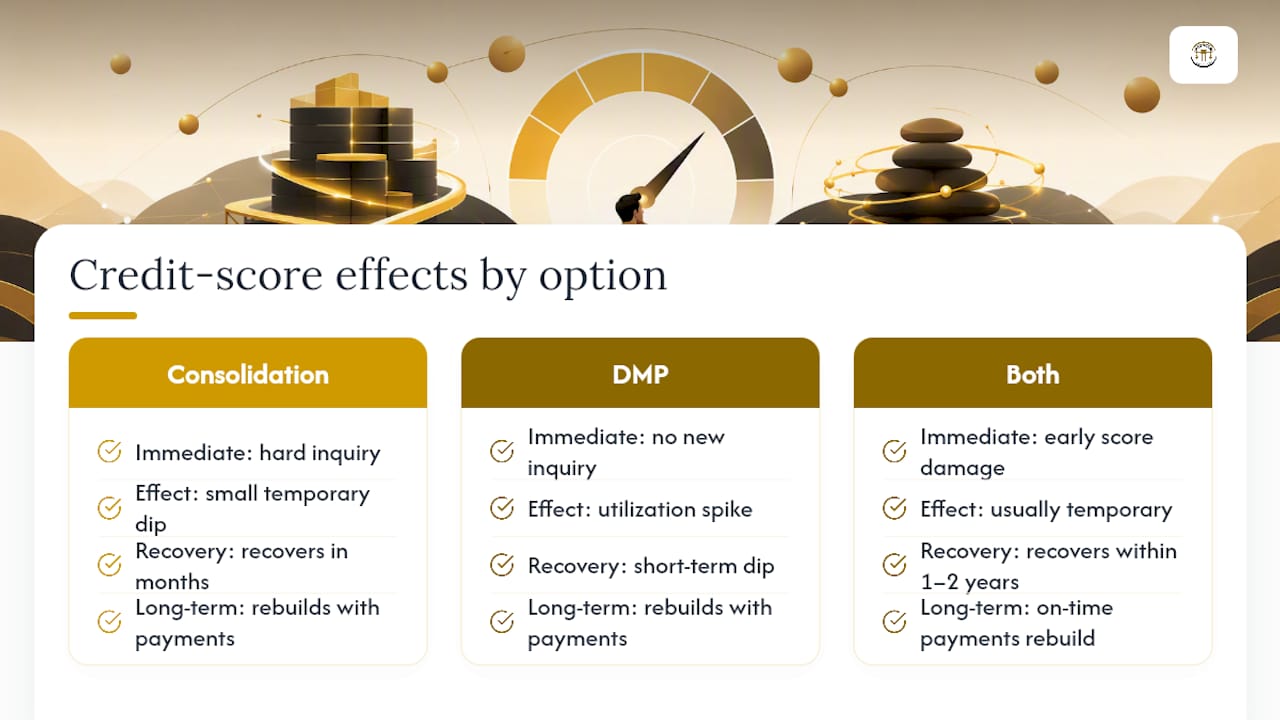
Consolidation triggers a hard inquiry when you apply, which can knock a few points off your score temporarily. That dip usually recovers within a few months if you keep payments current.
A DMP hits your score differently. Closing enrolled credit cards can spike your utilization ratio overnight, since your total available credit drops while balances stay roughly the same. Understanding how utilization drives your score helps explain why a DMP sometimes causes a short-term dip even though no new debt was added.
Both paths reward you the same way over time: consistent, on-time payments rebuild your score steadily, often outweighing the early damage within a year or two.
The real risk isn't the mechanics. It's behavior. Consolidation leaves your old credit lines open unless you close them yourself, and reopening spending habits on those freed-up cards is how people end up with the same debt twice. Set a calendar reminder to check your credit report every few months, and treat the freed-up limit as unavailable, not as a second chance to spend.
How to Choose Between Debt Consolidation and a Debt Management Plan
Start with four questions: What's your credit score? Can you comfortably meet your current minimum payments? Do you trust yourself with open credit lines? And how large and varied is your debt load?
If you answered "good score, yes I can pay, yes I trust myself," lean toward consolidation. If you answered "no" to any of the middle two, a DMP is usually the safer structure.
Before signing anything, ask the right questions of whoever you're working with.
- Lender questions: What's the APR, is there an origination fee, is there a penalty APR, and what's the total finance cost over the full term?
- Counselor questions: Is the agency accredited by the NFCC, what are the setup and monthly fees, what sample terms have they negotiated with your specific creditors, and what happens if a creditor declines?
- Either path: Ask for the total cost in dollars, not just a rate. A low APR with a high fee can cost more than a higher rate with no fee.
Watch for red flags: large upfront fees before any work begins, promises to "erase" your debt entirely, pressure to sign the same day, or an agency that isn't accredited. Genuine creditor negotiation takes documentation and time, not a same-day miracle.
Pro Tip: Call a nonprofit counseling agency before you apply for any consolidation loan. A free session often reveals whether your numbers actually support consolidation, or whether a DMP would save you more in the long run.
What Enrollment Actually Looks Like
Applying for a consolidation loan takes days: submit an application, get a rate quote, accept the terms, and the funds pay off your old creditors directly. Enrolling in a DMP takes longer up front. Expect a budget review, creditor outreach by the agency, and a proposal period before your first payment starts.
Typical costs stay within these ranges:
- Consolidation: origination fees around 1% to 8%, balance-transfer fees around 3% to 5%
- DMP: modest setup fee plus a monthly service fee, varying by state and agency
If a creditor refuses your DMP terms, the counselor typically restructures the proposal or negotiates account by account. Total finance cost, not the advertised rate, should always be the number you compare, according to MoneyLion's analysis of both structures.
Why the "Just Consolidate" Advice Gets People in Trouble
The instinct to grab the lowest advertised rate is exactly how people end up back in debt within two years. A loan with a great APR and a hefty origination fee can cost more than a plainer offer with no fee attached, once you run the full term. Start with free nonprofit counseling before comparing lender quotes. If you can't comfortably cover your current minimum payments today, a DMP is almost always the more honest starting point, not a consolidation loan dressed up as a fresh start. Many clients find that asking about total cost before monthly payment leads to better outcomes.
— Danny
Get Help Choosing the Right Path Forward
Pioneer Credit Solution gives you something most lenders and counseling agencies can't: a full financial lifecycle in one place, instead of a single product pushed on you regardless of fit. If your credit score is holding you back from the consolidation rates you actually want, credit repair services can raise your eligibility before you ever apply for a loan.

A free consultation starts with a real look at your credit profile, not a sales script. We walk through your score, your existing balances, and whether a personal loan makes sense for your situation or whether you'd be better served exploring negotiated relief first. Handling credit repair, loan matching, and business credit services together can help provide clearer guidance rather than pushing a single product. Book your free consultation today and find out which path actually fits your numbers.
Where to Verify This Information
The Consumer Financial Protection Bureau explains the legal differences between counseling, settlement, and consolidation. The National Foundation for Credit Counseling lists accredited agencies and DMP standards. Experian breaks down credit score requirements and scoring impact for both options.
This article is general information, not a substitute for advice from a qualified financial advisor. Consult a qualified financial professional about your own circumstances before acting on anything here.
Sources
- CFPB — What is the difference between credit counseling and debt settlement, debt consolidation, or credit repair?
- NFCC — Debt management plans (resource)
FAQ
Why Does Dave Ramsey Say Not to Consolidate Debt?
The concern is behavioral, not mathematical: consolidating debt can lower your monthly payment without fixing the spending habits that created the debt, leaving open credit lines available to refill. Financial experts generally agree consolidation works best paired with a firm budget, not as a standalone fix.
How Much Will I Pay Monthly on a $50,000 Debt Consolidation Loan?
Monthly payment depends entirely on the interest rate and term length, since a 5-year loan at a lower APR costs far less per month than a 2-year loan at a higher one. Get quotes from multiple lenders and compare total finance cost, including origination fees, before committing to a term.
What Are the Downsides of a Debt Management Plan?
The main downsides are enrolled credit cards typically getting closed or frozen, a program length that often runs 3 to 5 years, and the fact that creditors aren't legally required to accept the negotiated terms. Closing accounts can also cause a short-term rise in your credit utilization ratio.
How to Clear $30,000 Debt in a Year?
Paying off a large debt in a single year requires either an unusually large lump-sum payment or a very aggressive monthly budget, and most consolidation or DMP timelines are built around multi-year terms instead. If a one-year payoff isn't realistic given your income, a longer consolidation term or a DMP spread over 3 to 5 years is the more sustainable route, and improving your score first through credit repair can unlock better rates along the way.