
A D-U-N-S Number is a unique nine-digit business identifier issued by Dun & Bradstreet, used to confirm a company's identity and business credit file. You need one when a lender, supplier, large buyer, or government agency asks for it to verify your business before doing business with you. Looking one up or applying starts directly with Dun & Bradstreet, and for most companies, the number is free.
TL;DR:
- Many businesses already have a D-U-N-S Number due to automatic assignment from public records, so checking before applying prevents duplicates.
- Each physical location requires its own D-U-N-S Number, which can cause gaps if treated as a single company-wide ID.
- Applying for a D-U-N-S Number is free in the U.S., but standard processing takes up to 30 business days, or about 8 days with expedited fees.
- Ensuring consistent business name, address, and contact details across all documents speeds up verification and reduces delays.
- Accurate D&B profiles improve credit terms and more reliable financing approvals, but ongoing profile management is essential for benefits.
Table of Contents
- What Is a D-U-N-S Number, and Where Did It Come From?
- Who Actually Asks for Your D-U-N-S Number?
- How Do I Find My D-U-N-S Number If I Already Have One?
- How Do You Get a D-U-N-S Number If You Don't Have One?
- Keeping Your D&B Business Profile Accurate
- Timeline, Fees, and the Mistakes That Slow You Down
- Practitioner Tips for a Smoother D-U-N-S Process
- Why Tracking Your D-U-N-S Number Matters for Credit Strategy
- Get Hands-On Help With Your Business Credit Profile
- Sources
- FAQ
What Is a D-U-N-S Number, and Where Did It Come From?
Dun & Bradstreet created the Data Universal Numbering System in 1963 to give every business a distinct identity in its growing commercial database. That number became the backbone of how D&B builds a company's business credit profile, tracking everything from payment history to company size under one traceable ID.
The format is simple on the surface: nine digits, randomly generated, with no embedded meaning about location, industry, or founding date. Some records also carry a "DUNS+4" suffix, four extra digits companies use internally to separate departments or divisions without needing a whole new number, according to background documented on Wikipedia.
A few structural facts matter more than people expect:
- Each physical business location gets its own separate D-U-N-S Number, even if it's the same company.
- The nine digits carry no logic you can decode. Two sequential numbers can belong to unrelated businesses.
- The number stays tied to the legal entity and address it was issued for, which is why moving or restructuring can complicate your record.
Understanding this structure early saves you from one of the most common mistakes: assuming one number covers every storefront, warehouse, or branch a company operates.
Who Actually Asks for Your D-U-N-S Number?
Lenders, wholesale suppliers, and large corporate buyers are the most frequent requesters, and they're asking for a reason. Your D-U-N-S Number is the anchor for your D&B business credit profile, including scores like the Paydex score that reflect how reliably you pay vendors. A supplier extending net-30 terms wants to see that history before it takes the risk.
International partners rely on it too, since D-U-N-S functions as a common reference point across borders where local business registries don't always talk to each other. Investopedia notes it's especially useful when applying for grants, bidding on contracts, or working with retailers who require verified vendor identities before onboarding.
Here's where it gets requested in practice:
- Banks and alternative lenders evaluating a business loan or line of credit application.
- Wholesale distributors and retailers before approving a new vendor account.
- Some state and local procurement offices, alongside private-sector RFPs.
- International trading partners who need a standardized way to identify your company.
It's not always mandatory. A small local service business with no vendor accounts or loan applications pending might never need one. But the moment you're chasing financing, wholesale relationships, or a spot on a supplier list, it stops being optional in any practical sense.
How Do I Find My D-U-N-S Number If I Already Have One?
Many businesses already have a D-U-N-S Number without knowing it. D&B assigns them automatically from public records in some cases, which makes checking first a genuinely useful step before you assume you need to apply.
- Go to the official D‑U‑N‑S Number lookup tool run by Dun & Bradstreet.
- Enter your legal business name exactly as it appears on formation documents, plus your current address.
- Review the results carefully. Confirm the address, entity name, and any listed executive match your actual business.
- If multiple entries appear, check for old addresses or previous ownership. These usually indicate a duplicate or outdated record rather than a second valid number.
- If nothing comes back, move on to the application process rather than assuming the tool failed.
Pro Tip: Search with and without suffixes like "LLC" or "Inc." Small formatting differences between how you typed your name and how D&B recorded it can hide an existing number in plain sight.
Getting this step right avoids the far more common problem of ending up with two numbers for one business, which fragments your credit history right when you need it to look strongest.
How Do You Get a D-U-N-S Number If You Don't Have One?
Once you've confirmed no number exists, applying is direct, and for U.S. companies, it's free. You apply as an authorized representative of the business, meaning someone with the legal standing to speak for the company, usually an owner or officer.
- Gather your legal business name and any DBA, exactly as registered.
- Have your physical address ready. A P.O. box typically won't work for verification.
- Prepare your business phone number and the name of an owner or executive.
- Note your formation date, industry classification, and approximate employee count.
- Submit the application through Dun & Bradstreet's official channel.
- Respond promptly if D&B calls to verify details. This is a routine step, not a red flag.
Timing depends on how much of a rush you're in. Standard processing runs up to 30 business days, according to Dun & Bradstreet's own guidance, which is longer than most business owners expect when a lender or supplier deadline is looming. D&B also offers an expedited option for a fee that shortens the timeline to about a week or so. Chase's guidance for business owners confirms this same required information set, which is worth having assembled before you start rather than mid-application.
Keeping Your D&B Business Profile Accurate
Your D-U-N-S Number is only as useful as the information attached to it. D&B's D-U-N-S Manager and myD&B portal let U.S. non-public companies view and request updates to their records for free, and it's worth checking periodically rather than only when a problem surfaces.
Common updates include:
- A new address after relocating or opening a second location.
- Ownership changes following a sale, merger, or added partner.
- Legal name changes, which usually require supporting documentation like updated formation filings.
Consistency matters more than people assume. If your bank accounts, invoices, and state filings all list slightly different business names or addresses, lenders and suppliers checking your D&B file may hesitate, even when nothing is actually wrong. Keeping every document aligned with your official D&B record removes that friction entirely.
Timeline, Fees, and the Mistakes That Slow You Down
Standard D-U-N-S applications take up to 30 business days to process, with the paid expedited option cutting that to about 8 business days for businesses on a deadline.
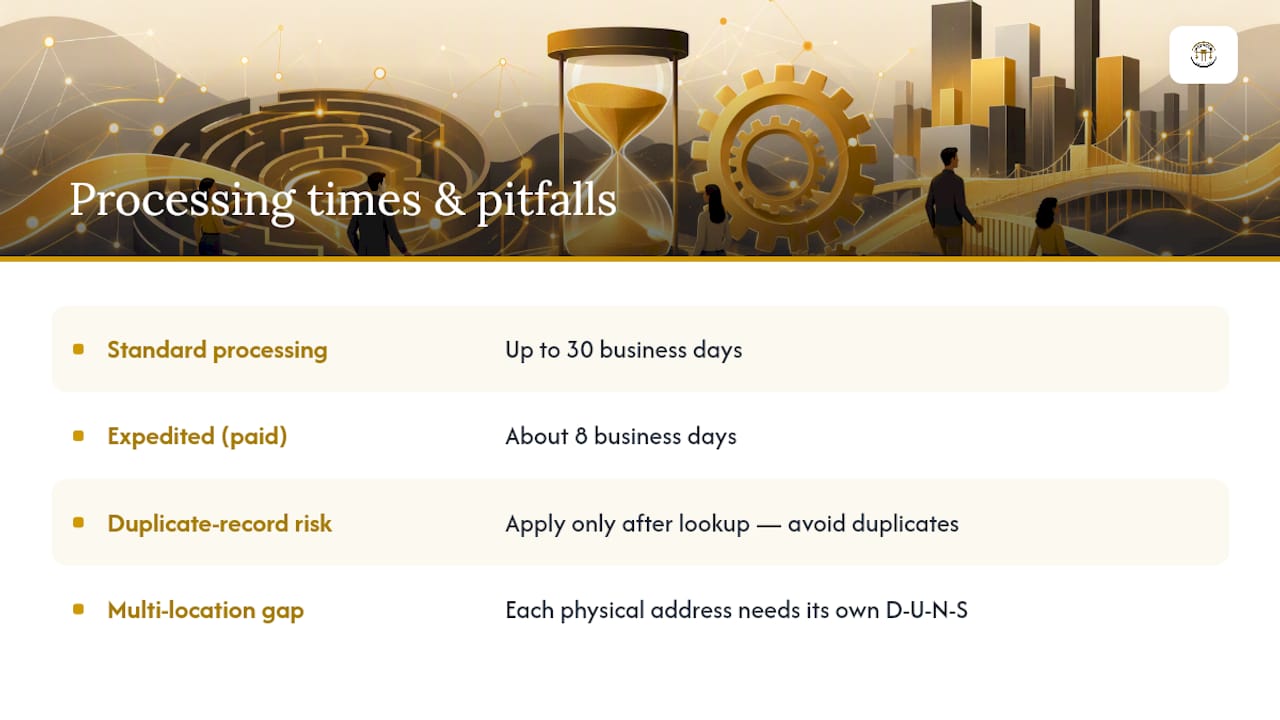
The most expensive mistake isn't the fee, though. It's applying for a number you already have. D&B frequently assigns D-U-N-S Numbers automatically from public records, so a business that never actively applied may already be in the system. Skipping the lookup step and applying anyway creates a duplicate record that splits your payment history across two files, weakening the very credit profile you're trying to build. Multi-location businesses face a related trap: each physical address needs its own separate number, and treating one number as company-wide creates gaps in coverage that show up later when a specific location applies for financing.
Practitioner Tips for a Smoother D-U-N-S Process
A little preparation prevents most delays. Before applying, confirm your legal name, address, and phone number match exactly across your Secretary of State filing, IRS records, and any existing marketing materials. Mismatches are the top reason D&B verification calls drag on.

Paying for expedited processing makes sense when a lender or contract deadline is genuinely days away. It's not worth the fee if you're applying months ahead of when you'll actually need the number.
Pro Tip: Once your number is active, treat your D&B profile like a living document. A business credit building service can help track vendor reporting and payment history consistency, since a D-U-N-S Number alone doesn't build credit. What happens under it does.
Why Tracking Your D-U-N-S Number Matters for Credit Strategy
Accurate D&B records translate directly into better terms. Lenders and suppliers read your profile before they read your pitch, and a clean, consistent record often means faster approvals and stronger rates. We've seen business owners spend months chasing financing that a five-minute D&B correction would have unlocked. If your profile feels murky, it's worth a conversation.
Get Hands-On Help With Your Business Credit Profile
A D-U-N-S Number gets you into the system, but it doesn't build your credit story on its own. That takes consistent vendor reporting, accurate documentation, and someone watching the details while you run your business. Some business credit building services combine oversight with access to financing, so once your profile is accurate, you're not left wondering what to do with it.

Our business credit building service reviews your existing D&B profile, flags inconsistencies between your filings and your credit file, and helps you assemble the documentation D&B typically requires for updates or corrections. If you're also weighing financing options once your profile is solid, our financing resources cover business loans, lines of credit, and SBA options. This kind of support is optional and built for business owners who want a second set of eyes on the process rather than handling every step alone. Start with a free credit analysis to see where your current profile stands.
Sources
- D-U-N-S Number Questions: Start Here - Dun & Bradstreet
- DOJ grants taxonomy: DUNS number
- What Is a DUNS Number? Business Identification Explained - Investopedia
- DUNS Number - NerdWallet
- What is a DUNS number and how do you get one? - Chase for Business
FAQ
How do I find my D-U-N-S Number?
Use the official D-U-N-S lookup tool and search with your exact legal business name and current address. Many businesses already have a number assigned automatically from public records, so check before applying for a new one.
Is a D-U-N-S Number the same as an EIN?
No. An EIN is a tax identifier issued by the IRS for federal tax purposes, while a D-U-N-S Number identifies your business within Dun & Bradstreet's commercial credit system. You'll typically need both, and one doesn't replace the other for any purpose.
Do all LLCs have a D-U-N-S Number?
Not automatically. An LLC only has one if it applied directly or if D&B assigned one from public records, which happens for many active businesses without them realizing it. Checking the lookup tool is the fastest way to confirm your LLC's status.
How do I get a D-U-N-S Number for my LLC?
Apply through Dun & Bradstreet as an authorized representative, providing your legal name, address, phone number, formation date, and employee count. Standard processing takes up to 30 business days, with an expedited paid option available for roughly 8 business days.
Does a D-U-N-S Number replace the federal UEI?
No. The federal government moved to the Unique Entity Identifier through SAM.gov in April 2022 for federal contracts and grants. D-U-N-S remains widely required by private-sector lenders, suppliers, and many international partners, so most businesses still need both identifiers.