

Yes, you can often get a mortgage with collections on your credit report. Whether you must pay depends on the loan program, the type and age of the debt, and whether it's a judgment. FHA sets a threshold for cumulative non-medical collections at a specific amount that triggers additional underwriting requirements, conventional loans through Fannie Mae's automated system are often more forgiving on primary residences, and medical debt gets treated more leniently across the board. Start by pulling your credit reports and documenting every account.
TL;DR:
- Loans through Fannie Mae's DU are often more forgiving of unpaid collections than FHA or VA programs, which may require payoff if balances exceed certain thresholds.
- FHA loans consider collections under $2,000 as less critical, allowing lenders to avoid strict payoff requirements by using alternative DTI calculations.
- Judgments are almost universally treated as a major risk, requiring resolution before mortgage approval, regardless of the loan program.
- Medical collections are typically excluded from underwriting assessments, so they rarely influence mortgage eligibility.
- Proper preparation includes disputing inaccuracies, negotiating in writing, writing explanations, and prioritizing judgments for faster approval.
Table of Contents
- How Collections and Judgments Affect Mortgage Approval
- FHA, VA, USDA, and Conventional Rules on Collections
- Your Pre-Application Checklist Before You Apply
- What Underwriters Want to See in Your File
- Choosing Your Path: Pay, Plan, or Preserve Cash
- How Pioneer Credit Solution Helps You Get Mortgage-Ready
- Why the "Pay It Off Now" Advice Misses the Point
- Get Your Credit File Mortgage-Ready
- Sources
- FAQ
How Collections and Judgments Affect Mortgage Approval
Not every derogatory mark on your credit report gets treated the same way by a mortgage underwriter, and the differences matter more than most homebuyers realize.
A collection account is a debt that's been sold or assigned to a third-party agency after the original creditor gave up trying to collect it directly. A charge-off happens when a creditor writes off the debt as a loss on its books, though it can still sell that debt to collectors later. A judgment is different: it's a court ruling that legally obligates you to pay, often with the creditor's ability to garnish wages or place a lien on property. A medical collection is simply a collection account tied to unpaid healthcare bills, and lenders increasingly carve out separate rules for it.
Your credit score reacts to all four in roughly the same negative direction. Underwriters don't. A conventional loan program running through Fannie Mae's Desktop Underwriter can often accept a file with old, unpaid collections on a primary residence purchase, while that same underwriter will almost never close a loan with an active, unresolved judgment sitting on the title search.
Where collections get expensive is in your debt-to-income ratio, or DTI. If a lender decides your collection needs to be counted as a monthly liability, either because you're on a payment plan or because the program requires it, that payment adds to your DTI and can shrink your loan amount or push you over qualifying limits.
Timing matters too. The Consumer Financial Protection Bureau notes that state statutes of limitation on debt collection lawsuits vary widely, but negative items typically stay on your credit report for up to seven years from the date of delinquency regardless of whether a collector can still sue you for it. That distinction trips up a lot of borrowers: a debt can be legally uncollectible in court and still be sitting on your file, dragging down your score.
A few practical takeaways before you dig into program specifics:
- Collections and charge-offs hurt your score similarly, but underwriters weigh them differently by loan type.
- Judgments carry the highest risk because they represent an active legal claim, not just a reporting entry.
- Medical collections are increasingly excluded from underwriting decisions, even when they still show up on your credit report.
- A collection only affects your DTI when a lender counts it as an active monthly obligation.
FHA, VA, USDA, and Conventional Rules on Collections
Loan program choice is the single biggest lever you have when collections are sitting on your file, and the rules diverge sharply.
FHA: the $2,000 threshold
FHA loans follow one of the more specific rules in the mortgage world. Per HUD Mortgagee Letter 2013-24, when your cumulative non-medical collection balances hit $2,000 or more, the lender has to run a capacity analysis. That doesn't automatically mean you have to pay everything off. The lender has three paths available:
- Verify the collections have been paid in full.
- Verify a payment arrangement is in place and count that monthly payment in your DTI.
- If no payment arrangement exists, calculate 5% of each collection's outstanding balance and add that figure to your monthly DTI.
That third option is the one most borrowers don't know about. It lets you keep cash in your pocket for closing costs or a down payment instead of paying off old debt, as long as your DTI can absorb the hit.
FHA collections under the cumulative non-medical balance threshold generally requires no special capacity analysis at all. That's the practical cutoff worth remembering if you're trying to predict how your file will be treated.
FHA loans that get an Accept or Approve through the TOTAL Scorecard automated underwriting system typically don't need extra documentation on collections. A Refer result, though, kicks the file into manual underwriting, where a loan officer will expect a written letter of explanation and supporting paperwork for every open collection account.
Conventional loans: Fannie Mae's borrower-friendly rule
Conventional financing through Fannie Mae's Desktop Underwriter (DU) is often the most forgiving path for a one-unit primary residence. According to the Fannie Mae Selling Guide, borrowers buying a primary residence are not required to pay off outstanding collections or non-mortgage charge-offs, regardless of the balance, when the loan runs through DU.
That's a meaningful contrast to FHA's hard dollar threshold. The exception comes with occupancy type: second homes, investment properties, and manually underwritten files carry different, often stricter, thresholds. If your loan gets flagged for manual review instead of an automated approval, expect the collection payoff conversation to resurface.
VA and USDA: underwriter discretion
VA and USDA loans don't publish a single bright-line dollar threshold the way FHA does. Underwriters on these programs have more discretion, but the practical approach tends to mirror FHA's logic: if there's no active payment arrangement, the underwriter may include roughly 5% of the outstanding collection balance in your DTI calculation. VA loans in particular emphasize residual income analysis alongside DTI, which can soften the impact of a collection that would sink a tighter conventional file.
Medical collections and judgments
Medical collections get a pass across nearly every program. Industry guidance on collections and charge-offs confirms that medical debt is commonly excluded from the capacity analysis and DTI calculations that apply to other collection types, reflecting how differently healthcare debt behaves compared with, say, an unpaid credit card sent to collections.
Judgments are the opposite story. Nearly every program treats an unresolved judgment as a closing blocker. Title companies flag judgments during the title search regardless of loan type, and most lenders will require payoff or a court-documented payment plan before they'll fund the loan. If you have a judgment on your record, that's the item to resolve first, before you worry about smaller collection accounts.
Your Pre-Application Checklist Before You Apply
Getting your file ready before you talk to a loan officer saves you weeks of back-and-forth during underwriting. Work through these steps in order.
- Pull all three credit reports. Get your reports from Equifax, Experian, and TransUnion and list every collection account with the original creditor name, current collector, balance, and date of last activity.
- Dispute anything inaccurate. If a balance looks wrong, the debt isn't yours, or it's past the point where it should have dropped off your report, file a dispute and keep the results in writing. Our guide on removing collections from your credit report walks through the dispute process step by step.
- Negotiate in writing. If you're going to set up a payment plan or settle a collection for less than the full balance, get the agreement in writing before you send a dollar. Verbal promises from a collector don't hold up in underwriting. Our piece on negotiating with creditors and debt collectors covers what to ask for.
- Draft a letter of explanation for each account. For every collection that will surface in your file, write a short, factual account of what happened, when, and what you've done to resolve it. Job loss, medical emergency, divorce, these are the kinds of documented circumstances underwriters are trained to weigh.
- Decide where your cash goes. Before writing a check to a collector, ask whether that money would do more good toward your down payment. The National Foundation for Credit Counseling advises borrowers to weigh whether paying off a collection actually improves loan terms enough to justify diverting funds that could otherwise increase a down payment.
- Resolve any judgment immediately. If a judgment shows up on your report or in a title search, treat it as priority one. Get it paid or get a court-documented payment plan in place well before you apply.
Pro Tip: Paying off a collection rarely moves your credit score much, and the paid account still shows on your report for seven years. The real payoff is underwriting risk, not your score, so weigh that before assuming payoff is always the right move.
What Underwriters Want to See in Your File
Automated underwriting systems, FHA's TOTAL Scorecard and Fannie Mae's DU, already factor collections into their risk assessment. An Accept or Approve result from either system generally means no extra letters or documentation are required for those accounts specifically.
A Refer result changes everything. That's the trigger for manual underwriting, and manual underwriting means paperwork. Here's what an underwriter typically wants to see once your file gets flagged:
- A letter of explanation for each open collection: what caused it, when it happened, and what steps you've taken since.
- Verification of payment arrangements, including a letter from the creditor or collector confirming the terms, plus bank statements or cancelled checks showing you've made payments on time.
- Payoff confirmation if you've settled or paid a collection, ideally a zero-balance letter from the collector, not just an updated credit report.
- DTI math backup showing how the lender arrived at your qualifying ratio, whether that's the actual payment on a verified plan or the FHA-style 5%-of-balance calculation.
Underwriters accept well-documented mitigating circumstances more often than borrowers expect. A letter of explanation with real supporting evidence, hospital bills, a termination notice, divorce decree, tends to carry far more weight in a manual underwrite than a vague, one-line excuse.
Choosing Your Path: Pay, Plan, or Preserve Cash
Once you know which program you're targeting, the decision usually comes down to a short set of rules.
- If your cumulative non-medical collections total under $2,000 and you're targeting FHA through an Accept result, or a conventional loan through DU on a primary residence, you likely don't need to pay anything off before closing.
- If your collections total $2,000 or more and you're on FHA, USDA, or a manually underwritten file, plan on either paying the balances, setting up a documented payment arrangement, or accepting the 5%-of-balance DTI hit.
- If a judgment is involved, resolve it before you do anything else. This isn't optional on nearly any program.
- If you're deciding between paying off collections and growing your down payment, run the math both ways. A larger down payment can lower your rate, drop your mortgage insurance, and reduce your monthly payment more than a collection payoff typically will.
- If your file is complicated, multiple collections, a mix of medical and non-medical debt, or you're not sure which program fits, get a second set of eyes from a credit counselor, an experienced loan officer, or a credit-repair professional before you submit an application.
Our overview on qualifying for a mortgage with bad credit breaks down how these decisions interact with your broader credit profile, not just the collections themselves.
How Pioneer Credit Solution Helps You Get Mortgage-Ready
Sorting out which collections to pay, which to document, and which to leave alone takes more than a quick credit pull. Pioneer Credit Solution works directly with clients preparing for a mortgage application, disputing inaccurate items, negotiating with collectors, and building the documentation underwriters actually ask for. We track progress using SmartCredit technology, giving you a real-time view of your report as changes take effect.
Many clients have reported significant credit score increases, and we have experience assisting a large number of customers with credit cleanup. If your file has a handful of straightforward collections and you're comfortable writing letters of explanation yourself, DIY may work. If you're juggling multiple accounts, a judgment, or a tight closing timeline, professional help usually moves faster. Our mortgage-readiness credit repair service is built around exactly that timeline pressure.
Why the "Pay It Off Now" Advice Misses the Point
Most articles on this topic treat paying off collections as the obvious, responsible move. The research doesn't back that up as a universal rule. Fannie Mae's own DU guidance lets primary-residence borrowers skip payoff entirely, and FHA gives you a 5%-of-balance alternative specifically so you're not forced to drain your savings on old debt.
The conventional wisdom also undersells how differently medical debt gets treated versus everything else. Lumping a $400 medical bill in collections with a $3,000 unpaid credit card is a mistake almost every borrower makes when they first check their credit report, and it leads people to overpay on debt that underwriters were never going to weight heavily anyway.
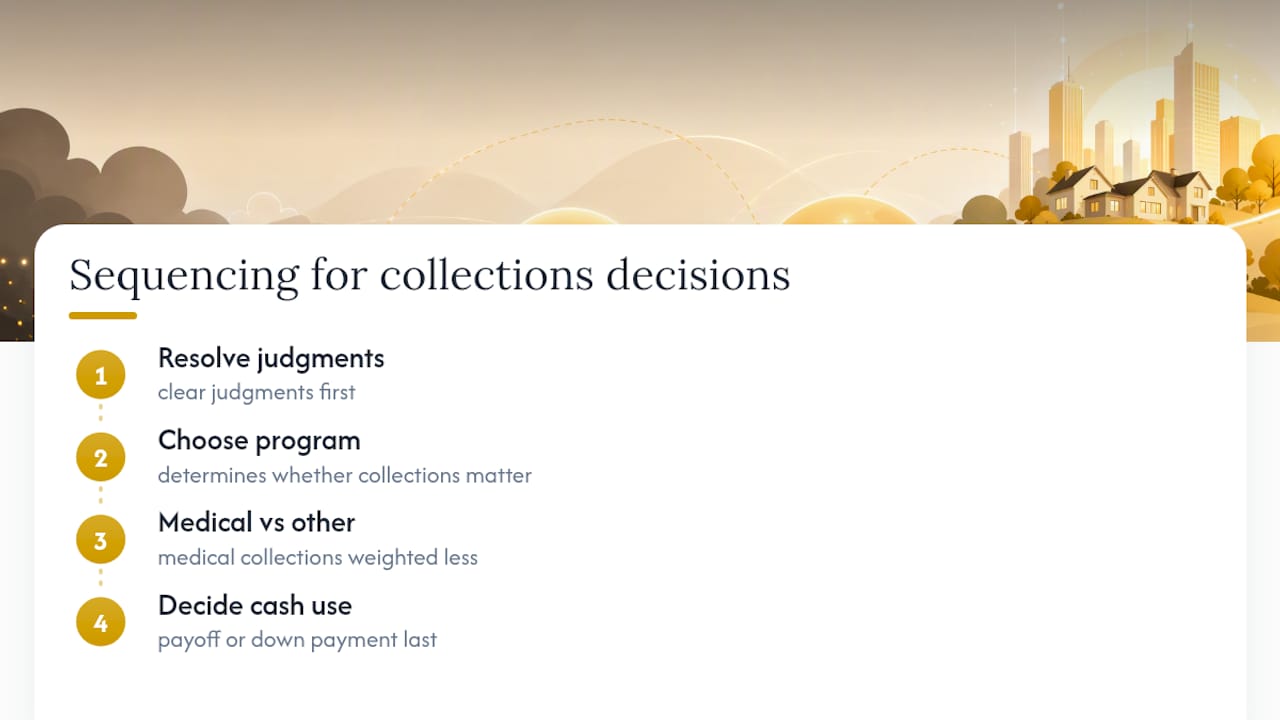
What actually matters is sequencing. Resolve judgments first, always. Then figure out which program you're targeting, because that decision determines whether a collection is a dealbreaker or a footnote. Only after that should you decide whether cash goes toward payoff or toward your down payment. Borrowers who skip straight to "pay everything off" often give up leverage they didn't need to give up.
— Danny
Get Your Credit File Mortgage-Ready
Figuring out on your own which collections need payoff, which need a documented plan, and which your target loan program will simply ignore is where most borrowers waste time, and money. Pioneer Credit Solution reviews your full credit picture against the specific program you're targeting, so you're not guessing at FHA's $2,000 threshold or hoping your file gets an automated Accept instead of a manual Refer.

We offer a free consultation to review your credit reports, flag collection accounts that need attention, and map out whether payoff, a payment plan, or preserving your down payment makes more sense for your situation. Bring your three-bureau credit reports, details on each collection account (balances, collector names, last activity dates), and proof of income to your consult. If you're specifically preparing to buy a home, our mortgage-readiness credit repair page outlines what that process looks like from first call to closing table.
This article is general information, not a substitute for advice from a qualified financial advisor. Consult a qualified financial professional about your own circumstances before acting on anything here.
Sources
- HUD Mortgagee Letter 2013-24: Handling of Collections and Disputed Accounts
- Fannie Mae Selling Guide — DU credit report analysis
- CFPB: Can debt collectors collect a debt that's several years old?
- National Foundation for Credit Counseling (NFCC)
- Mortgageloans
FAQ
Can You Get an FHA Loan With Collection Accounts?
Yes.
What Happens If a Mortgage Goes to Collections?
A mortgage that goes to collections typically means the loan has already defaulted and moved toward foreclosure proceedings, which is a far more serious event than an unpaid credit card or medical bill landing in collections. That scenario damages your credit far more severely and takes longer to recover from than a standard collection account.
Can You Have a 700 Credit Score With a Collection?
It's possible, especially with an older, smaller, or paid collection sitting alongside strong on-time payment history elsewhere on your file. Score models weigh recency and severity, so a single small collection from years ago has a much smaller impact than a fresh, large one.
Can I Get a Home Loan With Bad Credit and Collections?
Yes, though your options narrow and your rate may run higher. FHA and conventional loans through Fannie Mae's DU system both have documented paths for approving borrowers with collections, particularly on primary residence purchases, as long as judgments and major derogatory items are resolved first.
Do Medical Collections Affect Mortgage Approval the Same Way as Other Debt?
No. Medical collections are commonly excluded from the capacity analysis and DTI calculations that apply to other collection types across FHA, conventional, and most other programs, which is why lenders often disregard them even when they still appear on your credit report.