
Notarizing a will is not required for legal validity in nearly every U.S. state, but it usually helps. What makes a will valid is proper witnessing, typically two disinterested witnesses signing in your presence. Notarization becomes valuable when paired with a self-proving affidavit, which lets probate courts skip tracking down witnesses later.
TL;DR:
- Notarization is optional in most states but adds a self-proving affidavit, which helps probate courts accept the will without tracking down witnesses later.
- Louisiana's formal civil-law notarial testament requires a notary and witnesses in a single ceremony, differing from common-law rules elsewhere.
- Remote online notarization is permitted in some states for wills, but its legality varies and should be confirmed before use.
- Notaries only verify identity and voluntary signing; they do not assess the legal soundness or content of the will.
- Common mistakes include skipping witnesses, using interested witnesses, or signing pages at different times, which can invalidate a will.
Table of Contents
- Do You Need to Notarize a Will? State Rules and Exceptions
- What Notarization Actually Does for Your Will
- How to Get Your Will Notarized: A Signing Checklist
- Where to Get a Will Notarized: In-Person, Mobile, and RON
- Common Mistakes That Can Invalidate a Will
- A Practical Take on Notarizing Your Will
- Get Help Notarizing and Preparing Your Will
- Where to Verify Your State's Rules
- Sources
- FAQ
Do You Need to Notarize a Will? State Rules and Exceptions
Most states follow the same basic formula for a valid will: the person making it (the testator) must sign it, and two witnesses must watch that signing and sign themselves. Notarization sits outside that formula entirely in most jurisdictions. You can have a perfectly valid will that no notary has ever touched, as long as the witness requirement was handled correctly.
The exceptions matter, and skipping them can cost a family real time and money in probate court.
- Louisiana uses a civil-law "notarial testament" model, where a notary and witnesses jointly execute the will in a single, more formal ceremony, closer to the Napoleonic legal tradition than the common-law approach used elsewhere.
- Colorado and North Dakota allow a notarized will to substitute for the usual witness requirement, an unusual carve-out most states don't offer.
- Pennsylvania has its own quirks around self-proving affidavits and how they're executed, so a form that works in a neighboring state won't automatically satisfy Pennsylvania's rules.
- Holographic wills (handwritten, unwitnessed) are recognized in some states but not others, and notarization does not fix a holographic will that fails to meet its state's specific requirements.
- Electronic wills are gaining ground state by state, often paired with remote online notarization, but the legal framework is still uneven and worth confirming before you rely on it.
Check your state's specific requirements before assuming your draft meets the bar, since the differences between neighboring states can be significant.
What Notarization Actually Does for Your Will
A notary's job is narrow: verify your identity, confirm you're signing voluntarily, and witness the signature. That's it. A notary is not evaluating whether your will is legally sound, and under state notary rules, they're barred from giving legal advice or drafting language for you.
Two notarial acts show up around wills, and the difference matters:
- Jurat: you sign in front of the notary and swear to the contents, most commonly used for the self-proving affidavit.
- Acknowledgement: you confirm you already signed the document and it's genuinely yours, sometimes used when a will was signed earlier.
The real payoff is the self-proving affidavit. Attach one, and a probate court can typically accept your will without live witness testimony, which matters enormously years later when witnesses have moved, lost touch, or died. A properly executed affidavit often eliminates the need to track anyone down at all. What notarization does not do is prove you had testamentary capacity or shield your will from a contest over undue influence. Those fights happen regardless of the notary stamp.
How to Get Your Will Notarized: A Signing Checklist
Getting this right takes one focused appointment. Rushing it, or splitting it across two sessions, is how families end up back in court.
- Finalize your draft first. Don't sign anything in advance unless your notary is specifically acknowledging a document you already executed under a state process that allows it.
- Bring valid government ID, and confirm your two witnesses are present, not just available by phone, and that they'll be reachable if the court has follow-up questions years from now.
- Sign the will itself in front of everyone in the room, then have the witnesses sign.
- Complete the self-proving affidavit as a jurat: the notary administers an oath, watches you and the witnesses sign the affidavit, then completes their certificate and journal entry per National Notary Association guidance.
- If you're homebound, schedule a mobile notary who can bring the entire signing ceremony to your home or a hospital room.
- If your state permits remote online notarization, confirm the RON platform's witness procedures before your appointment, not during it.
Pro Tip: Print two extra copies of the affidavit page before your appointment. A torn or miswritten jurat page is a common reason signings get rescheduled.
Where to Get a Will Notarized: In-Person, Mobile, and RON
Your options fall into three categories, and the right one depends on mobility, urgency, and what your state allows.
- In-person locations: some bank branches notarize documents for account holders, often free; law firms and shipping stores like UPS locations typically charge a small per-signature fee; county clerk offices sometimes offer it at low or no cost.
- Mobile notary: a notary travels to your home, hospital, or care facility, which is worth the added travel fee when a homebound testator can't manage a trip. Have your ID, draft, and witnesses arranged before they arrive.
- Remote online notarization (RON): permitted for estate documents in many U.S. states, RON records the entire session and can supply professional witnesses through platforms designed for this. Confirm your state's RON statute actually covers wills before you build your plan around it, since adoption varies and some states still exclude wills specifically.
Common Mistakes That Can Invalidate a Will
Most will disputes trace back to a handful of avoidable errors at the signing table.
- Skipping witnesses because a notary was present. A notary stamp doesn't replace the witness requirement in most states; if you want notarization's benefits, add a self-proving affidavit on top of proper witnessing, not instead of it.
- Using interested witnesses, meaning someone who inherits under the will. Choose disinterested witnesses, or confirm your state's specific rule on this before the appointment.
- A notary offering to draft or explain will language. That's a red flag. Notaries can't give legal advice, and one who tries should prompt you to consult an attorney instead.
- Signing pages at different times or without everyone in the room together. Do the entire ceremony in one sitting, start to finish.
Pro Tip: If your notary is also serving as one of your two witnesses, they'll need to sign twice, once as a witness on the will and once in their notarial capacity on the affidavit. Those two signatures should look distinct on the page.
A Practical Take on Notarizing Your Will
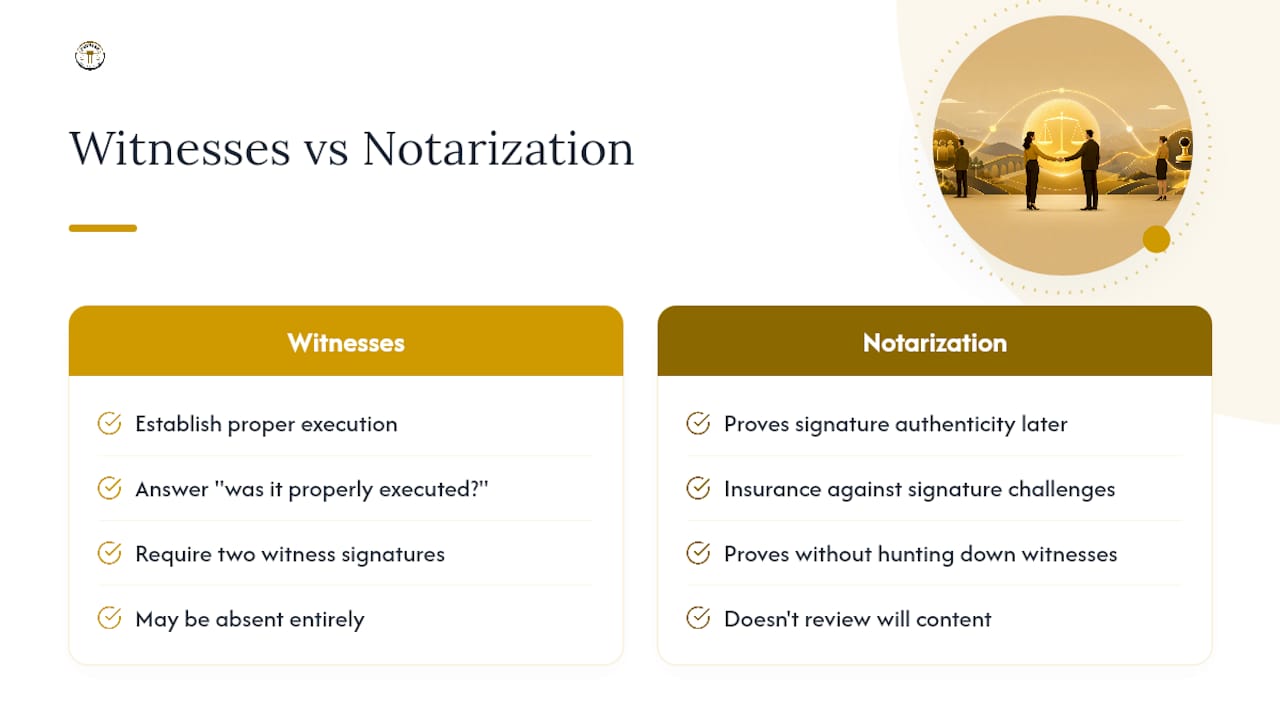
People treat notarization like a legal seal of approval, and that's the wrong mental model. It's closer to insurance against a very specific, narrow risk: someone showing up in probate court claiming the signature isn't real or the signing wasn't voluntary. Witnesses handle the "was this will properly executed" question. Notarization handles the "can we prove it years later without hunting down two people" question. Confusing those two roles is exactly how families end up learning too late that their loved one's will, notarized beautifully, has no witness signatures at all.
The other pattern worth naming: people expect a notary to catch problems in the will itself, missing clauses, ambiguous language, an outdated executor. Notaries aren't reading your will for content. They're confirming you're you and you're signing on purpose. If your estate involves a blended family, a business, or anyone likely to contest, that gap between what notarization protects against and what it doesn't is where real legal review earns its cost.
Estate planning services, including living trusts and mobile notary support, exist to help you get these documents built correctly and executed the right way the first time. Danny's related coverage on estate planning and credit building reflects that same practical, no-fluff approach to financial documents that matter. None of this is a substitute for personalized legal advice, and if your estate is contested, complex, or involves significant assets, talk to an estate attorney before you rely on any general guide, including this one.
— Danny
Get Help Notarizing and Preparing Your Will
There are options for readers who want their notarization handled alongside the rest of their financial plan instead of juggling a bank branch, a shipping store, and a separate estate attorney. Mobile notary services that come to your home for the actual signing and estate-planning support that covers wills, living trusts, and special needs trusts can assist if your situation calls for more than a basic will.

Scheduling starts with a consultation where we walk through what your document needs, whether that's a straightforward self-proving affidavit or a more layered estate plan, and flag any travel fees upfront before you commit. If your estate is contested or involves complicated ownership structures, we'll tell you that plainly and point you toward an estate attorney rather than take on something outside our scope. For most families with a standard will that needs proper execution, get your free consultation and get your notarization scheduled this week.
Where to Verify Your State's Rules
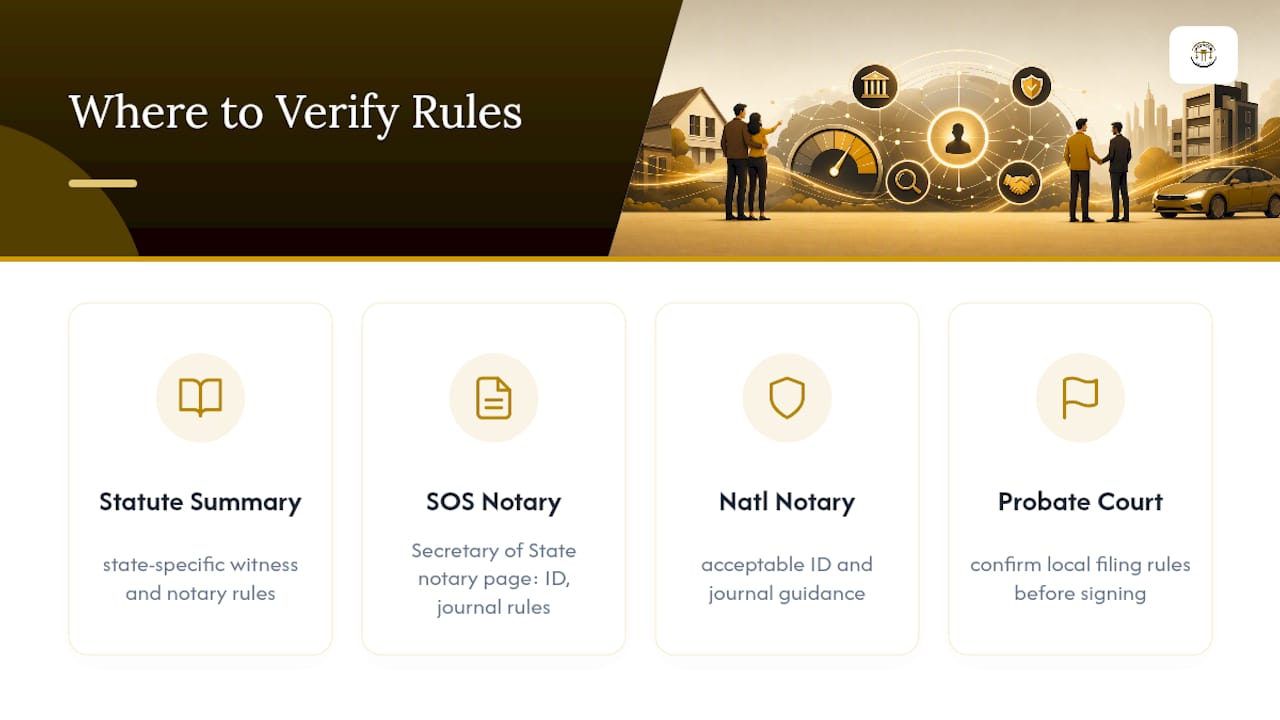
For state-specific witness and notarization requirements, check your state's statute summary, your state's Secretary of State notary page, and National Notary Association resources for acceptable ID and journal standards. Always confirm your local probate court's filing rules before your signing appointment.
This article is general information, not a substitute for advice from a qualified lawyer. Consult a qualified legal professional about your own circumstances before acting on anything here.
Sources
- Making your estate planning documents official: Remote online notarization in each state
- Is a Notarized Will Legal? Not Without Witnesses — LegalClarity
- National Notary Association — Notary resources
FAQ
Can any notary notarize a will?
Most commissioned notaries can notarize a will's self-proving affidavit, but state rules on presence, ID, and journal entries still apply. Some notaries decline if the document isn't already properly drafted, since an incorrectly handled affidavit can create bigger problems later.
Do living wills need to be notarized in Ohio?
Ohio's living will (an advance healthcare directive, different from a last will and testament) generally requires either witnesses or notarization, not both, depending on how it's executed. Check current Ohio statute language directly, since requirements for healthcare directives differ from those for a last will and testament.
Does a Florida will need to be notarized?
No. Florida requires two witnesses for a valid will, and notarization is optional but strongly recommended because it enables the self-proving affidavit that speeds up probate. Florida also has specific rules for who can serve as a witness, so confirm those before your signing.
Is a will legal if it's just notarized?
In nearly every state, notarization alone does not make a will legal if the required witnesses are missing. Witnesses establish validity; notarization mainly adds the self-proving affidavit that makes probate faster and easier for your family.