
Pay-for-delete is legal for you to propose, but no law forces a collector to accept it, and results vary widely depending on who owns your debt. Success hinges on timing and documentation: never send money until you have a signed agreement demanding removal from Equifax, Experian, and TransUnion. In some cases, simply paying and getting a "paid" status is enough, since newer scoring models ignore paid collections entirely.
TL;DR:
- Success with pay-for-delete largely depends on whether the debt is owned by a third-party collector, with these accounts being more likely to delete upon payment.
- Collectors report to all three bureaus at different times, so you must verify deletion on each report after several weeks using free annual credit reports.
- Paying off a debt with FICO 9 or VantageScore models may not require deletion, as these scoring algorithms ignore paid collections entirely.
- Never pay until you receive a signed agreement specifying deletion from all three bureaus, and always use traceable funds like a cashier's check.
- Working with a professional service can improve the chances of successful negotiations, especially for multiple accounts or when facing uncooperative collectors.
Table of Contents
- What Is Pay for Delete and How Does It Work?
- Is Pay-for-Delete Legal Under the FCRA?
- When Does Pay-for-Delete Actually Work?
- How Do You Request a Pay-for-Delete Agreement Safely?
- What Should a Pay-for-Delete Letter Include?
- What Are the Alternatives to Pay-for-Delete?
- What Does a Compliant Pay-for-Delete Process Look Like?
- When Do I Recommend Pay-for-Delete, and When Do I Steer Clients Elsewhere?
- How Pioneer Credit Solution Can Help With Collection Negotiations
- Primary Sources and Further Reading
- Sources
- FAQ
What Is Pay for Delete and How Does It Work?
Pay for delete is a negotiation where you offer a debt collector payment in exchange for a written promise to remove the collection tradeline from your credit reports. Three parties are typically involved: you, the collection agency (or original creditor), and the three major credit bureaus that maintain your files.
Deletion removes the collection tradeline itself, but it doesn't erase everything connected to the debt. If the original creditor also reported late payments before selling the account to a collector, those late-payment entries often stay on your report even after the collection line disappears. This distinction trips up a lot of people who assume one deletion wipes the slate clean.
Once a collector agrees and you pay, the bureaus typically need time to process the update:
- Most agreements specify a reporting window of several weeks after payment.
- You should pull reports from all three bureaus, not just one, since collectors don't always report to all three simultaneously.
- Free reports are available year round through Annualcreditreport, which lets you confirm whether the deletion actually posted.
If the tradeline is still showing after that window, you have grounds to follow up in writing before assuming the agreement failed.
Is Pay-for-Delete Legal Under the FCRA?
Yes, proposing pay-for-delete is legal for you as a consumer. What's not guaranteed is a collector's willingness to say yes, and federal law explains why. The Fair Credit Reporting Act requires furnishers, meaning the collectors and creditors who report to the bureaus, to provide accurate information. That obligation is precisely why many collection agencies refuse deletion requests even when you offer full payment: agreeing to delete an accurate, verified debt puts them in a gray area with their own compliance policies.
The legal reality in three parts:
- The FCRA doesn't ban pay-for-delete agreements outright, but it does create the accuracy pressure that makes many furnishers say no.
- The Fair Debt Collection Practices Act gives you separate rights around how collectors can contact and pressure you, distinct from FCRA's reporting-accuracy rules.
- You have the right to request debt validation, meaning the collector must show proof they own the debt and the amount is correct, according to CFPB guidance on debt collector disclosures.
Statistic Callout: Legal analysts at LegalClarity note that pay-for-delete isn't illegal for consumers to request, but they recommend a written agreement, a debt validation request, and a 30 to 45 day wait before assuming deletion failed, the same window bureaus typically need to update files.
Before you negotiate anything, check your state's statute of limitations on debt. Paying even a small amount on time-barred debt can sometimes restart the clock in certain states, so confirm this first. If a collector misreports information after promising deletion, your state attorney general's consumer protection office is a legitimate escalation path.
When Does Pay-for-Delete Actually Work?
Who owns the debt changes everything. Debt buyers, companies that purchase old accounts for pennies on the dollar, often have more flexibility to agree to deletion because their business model is built around recovering something, not preserving a pristine credit file. Original creditors, banks, hospitals, and utility companies, rarely agree to delete because they have internal policies against altering accurate records and less financial incentive to bend.
Factors that improve your odds:
- The account has changed hands to a third-party collector rather than sitting with the original creditor.
- The debt is older, since aging accounts are closer to falling off your report anyway and collectors would rather close the file than keep chasing it.
- The balance is small enough that the collector sees more value in a quick settlement than a prolonged negotiation.
- Documentation on the collector's side is thin, giving you more leverage if you request validation.
Scoring models matter too. Older FICO versions weigh unpaid collections heavily, but FICO 9 and VantageScore ignore paid collections in their calculations, which changes whether deletion is worth pursuing at all for some lending situations.
Pro Tip: Before negotiating, ask your target lender which scoring model they pull. If it's FICO 9 or a recent VantageScore version, paying the collection down to zero might accomplish nearly as much as a full deletion, without the negotiation headache.
Prioritize accounts with debt buyers, older balances, and small dollar amounts first. Those are your best shots. Original-creditor accounts and very recent collections are usually a lower-percentage play.
How Do You Request a Pay-for-Delete Agreement Safely?
Follow this order and don't skip steps, especially the ones involving paperwork before payment.
- Pull your reports. Get your files from all three bureaus and confirm the account number, balance, and collector name match what's listed.
- Request debt validation. Send a validation request if you haven't already, and confirm the debt is actually yours and within the statute of limitations for your state.
- Draft a written offer. Specify the exact payment amount, a firm deadline, and a clear deletion condition covering Equifax, Experian, and TransUnion by name.
- Send it correctly. Mail your offer via certified mail with a return receipt to the collector's compliance or legal department, not a general customer service address.
- Wait for signed acceptance. Do not pay until you receive a signed reply confirming the deletion terms. A verbal promise from a phone representative means nothing if it isn't in writing.
- Pay with traceable funds. Use a cashier's check or money order, and keep copies of everything.
- Verify after 30 to 45 days. Pull your reports again and confirm the tradeline is gone from all three bureaus.
A few things to keep in mind as you work through this list:
- Never pay by personal check or direct bank transfer where the collector could cash it without confirming the agreement in writing.
- Keep your certified mail receipt and the signed agreement together, since you'll need both if you have to dispute a broken promise.
- If deletion doesn't show after the window, dispute the error directly with the bureaus rather than assuming nothing can be done.
The negotiation itself often benefits from research into standard negotiating tactics with creditors and collectors, since collectors expect counteroffers and rarely accept your first number outright.
What Should a Pay-for-Delete Letter Include?
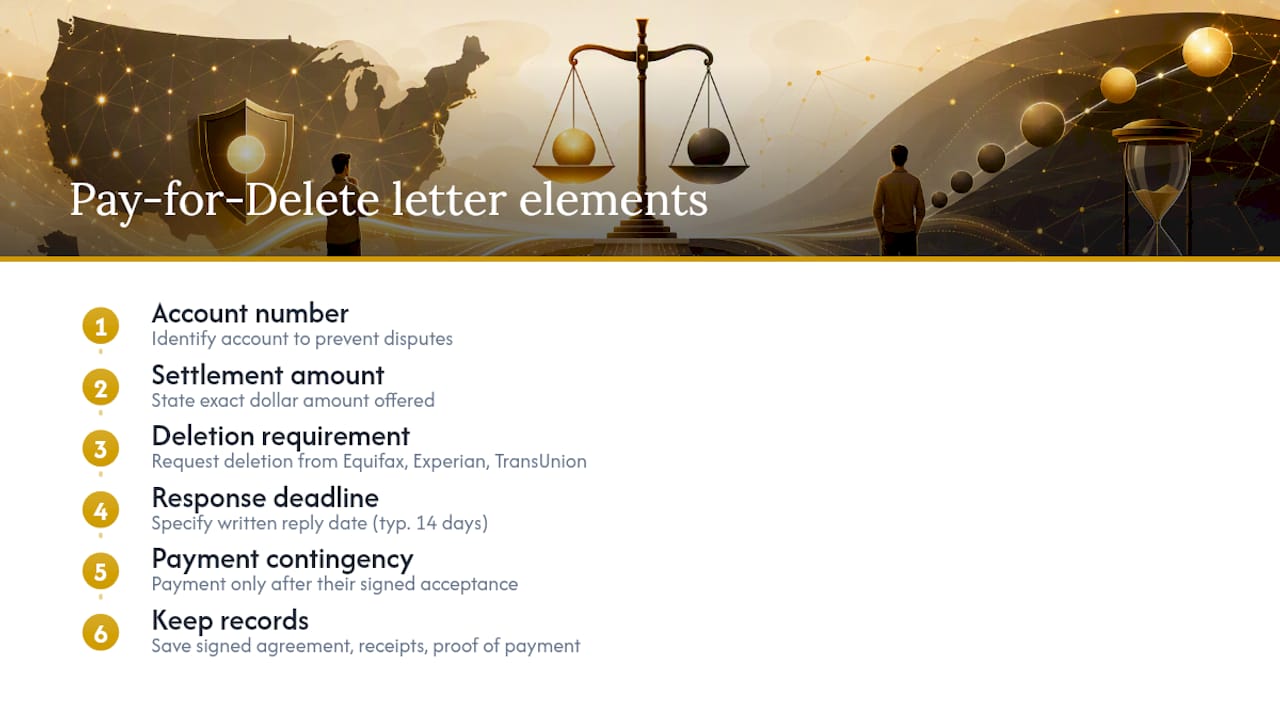
Your letter needs five elements to protect you: the account number, the exact settlement amount you're offering, a specific deletion requirement naming all three bureaus, a response deadline, and a clause making payment contingent on their signed acceptance first.
Here's a sample structure you can adapt:
Re: Account #[XXXXXXXX]
I am writing to propose a settlement of $[amount] to resolve the above account in full. This offer is contingent upon your agency's written agreement to request deletion of this tradeline from Equifax, Experian, and TransUnion within 30 days of receiving payment. Please respond in writing by [date, typically 14 days out]. No payment will be sent until I receive your signed acceptance of these terms.
Each clause does a specific job. The account number prevents disputes about which debt you're addressing. The deadline forces a decision instead of letting the request sit indefinitely. The contingency clause is the most important line in the letter: it legally protects you from paying and then getting nothing in return.
Keep copies of the signed agreement, your certified mail receipts, and proof of payment in one folder. If the collector fails to follow through, that documentation is what makes a dispute or an attorney general complaint credible instead of he-said-she-said.
What Are the Alternatives to Pay-for-Delete?
Pay-for-delete isn't your only path, and for a lot of situations it isn't even the most efficient one.
- Pay in full or settle without a deletion demand. Since FICO 9 and VantageScore ignore paid collections, paying down the balance can accomplish nearly the same credit outcome, especially if your lender uses a modern scoring model. Ask the lender which model they pull before deciding.
- Dispute inaccurate information instead of negotiating. If any detail on the tradeline is wrong, the amount, the dates, the account status, you can request bureau investigation and validation without paying anything.
- Ask for a goodwill deletion. This works best with original creditors on accounts you've since paid off, especially if you had a clean history before one late payment.
- Work with a nonprofit credit counseling agency if you're juggling multiple collections and need a structured repayment plan instead of one-off negotiations.
- Let time run its course. Most negative items fall off your report after seven years regardless of what you do, which sometimes makes waiting the simplest option for older, small-balance debts.
Medical collections deserve a special note. A CFPB rule finalized in 2025 changes how medical debt is treated on credit reports, which means pay-for-delete may be unnecessary for medical accounts depending on your situation.
What Does a Compliant Pay-for-Delete Process Look Like?
A workable process leans on documentation at every step, not just good intentions. Working through hundreds of collection cases, certain patterns hold up: written agreements before payment, verified debt ownership, and a hard rule against sending money on a verbal promise.
The non-negotiables in any compliant workflow:
- A signed agreement naming the specific account and all three bureaus by name, not a vague promise to "take care of it."
- A debt validation request completed before any settlement talk begins.
- Certified mail with return receipts for every offer and every acceptance.
- A 30 to 45 day verification window built into the timeline, with a follow-up dispute ready if deletion doesn't post.
Pro Tip: If you're negotiating multiple collection accounts at once, track each one separately with its own deadline and documentation folder. Mixing timelines across accounts is the most common reason people lose track of which collector actually agreed to what.
DIY negotiation works fine for a single account with clear documentation and a cooperative debt buyer. It makes less sense when you're juggling several accounts, facing an uncooperative original creditor, or unsure whether a debt is even within the statute of limitations. That's when professional help earns its cost through sheer negotiation bandwidth.
When Do I Recommend Pay-for-Delete, and When Do I Steer Clients Elsewhere?
Pay-for-delete earns its effort when you're prepping for a mortgage application and the underwriter is pulling an older FICO model that still penalizes unpaid collections, or when the debt sits with a responsive buyer who has clear incentive to close the file. Aged accounts under a few hundred dollars with third-party collectors are where I've seen the highest agreement rates.
I steer people away from it when the debt is time-barred, since reopening contact risks reviving a dead clock, or when the balance is a small medical bill likely to disappear under current reporting rules anyway. If your lender uses FICO 9 or a recent VantageScore, paying the balance often accomplishes just as much without the negotiation.
One rule I don't bend: never send a dollar before you have a signature in hand.
— Danny
How Pioneer Credit Solution Can Help With Collection Negotiations
Pioneer Credit Solution is the direct alternative to going it alone on a pay-for-delete negotiation, without the guesswork of drafting your own letters or chasing collectors for a signed reply. Where a solo consumer sends one offer and hopes for a response, our team handles documentation, validation requests, and follow-through across every account at once, so nothing slips through a missed deadline.

A free consultation covers a full review of your credit reports across all three bureaus, an assessment of which accounts are realistic candidates for negotiation, and a plan for handling collectors who refuse or go silent. Clients working with us have seen significant credit score increases, backed by thorough documentation practices. If you're ready to stop drafting letters solo, start with a free consultation and find out which accounts on your report are actually worth negotiating.
Primary Sources and Further Reading
For readers who want to verify the legal and procedural claims in this article directly:
- Fair Credit Reporting Act (FTC), the federal law governing furnisher accuracy requirements.
- CFPB: What information does a debt collector have to give me about the debt?
- Disputing errors on your credit reports (FTC consumer guidance)
- How to Remove Collections from Your Credit Report, for a deeper walkthrough of removal methods.
- How to Dispute Errors on Your Credit Report Successfully
This article is general information, not a substitute for advice from a qualified financial advisor. Consult a qualified financial professional about your own circumstances before acting on anything here.
Sources
- Fair Credit Reporting Act (FTC)
- Disputing errors on your credit reports (FTC consumer guidance)
- CFPB: What information does a debt collector have to give me about the debt?
FAQ
Is Pay for Delete Illegal?
No. Proposing pay-for-delete is legal for you as a consumer, but the FCRA's accuracy requirements mean many collectors decline the request even when it's offered.
How Likely Is a Pay-for-Delete Agreement to Succeed?
Success depends heavily on who owns the debt. Third-party debt buyers agree far more often than original creditors, and older, smaller balances tend to have better odds than recent, larger ones.
Does Pioneer Credit Solution Help With Pay-for-Delete Negotiations?
Pioneer Credit Solution handles documentation, validation requests, and negotiation follow-through for collection accounts as part of its credit repair services, which reduces the risk of a missed deadline or an unenforceable verbal promise.
How Much Should I Offer for Pay-for-Delete?
There's no fixed percentage that works across every account, but offers ranging from partial settlement to full balance are common, and your leverage improves when the debt is older or the balance is small enough that the collector prefers closing the file over prolonged collection efforts.
What Happens if a Collector Refuses to Delete After I Pay?
If deletion doesn't post within 30 to 45 days, pull your reports from all three bureaus and file a dispute directly using your signed agreement and payment proof as evidence.