
Federal student loan collections have resumed, and if your loan is in default, the clock is already running. Your one move right now is to contact the Default Resolution Group or log into MyEdDebt and either make a payment or start rehabilitation or consolidation. Notices carry strict 30 and 65 day windows, so acting this week protects your paycheck, your tax refund, and your benefits.
TL;DR:
- Borrowers in default must act within 30 to 65 days to prevent wage garnishments, tax refund offsets, or Social Security offsets from ongoing collection efforts.
- Rehabilitation requires nine on-time payments over about ten months to remove default marks, but it can only be used once per loan.
- Direct consolidation often offers a faster route out of default if three consecutive payments are made or if enrolled in an income-driven plan, though past default may still appear on credit reports.
- Federal agencies can garnish up to 15% of disposable pay through administrative wage garnishment without court judgment, unlike private lenders.
- Confirm debt validity and act within notice windows by requesting validation and documenting every contact to avoid mistaken or scam claims during default resolution.
Table of Contents
- How Federal Student Loan Collections Work
- How Do You Get Out of Default?
- What Deadlines Should You Watch For?
- What Can the Government Actually Take?
- How Do You Dispute or Challenge a Collections Notice?
- Where Can You Get Official Help?
- What Comes After You Resolve Default?
- How Pioneercreditsolution Can Help After You've Stopped Collections
- Sources
- FAQ
How Federal Student Loan Collections Work
Your loan enters default after 270 days without a payment. At that point, the full remaining balance becomes due immediately, a process called acceleration, and your loan may be transferred to the Department of Education's Default Resolution Group (DRG) for active collection.
From here, the government doesn't need to sue you the way a private lender would. The U.S. Department of Education can garnish wages, seize tax refunds, and in limited cases offset Social Security payments through purely administrative channels. Three tools do the heavy lifting:
- Administrative Wage Garnishment (AWG): up to 15% of your disposable pay, withheld directly by your employer.
- Treasury Offset Program (TOP): intercepts federal tax refunds and certain other federal payments.
- Social Security offset: applies in narrower circumstances, typically after other collection attempts have failed.
This is the single biggest difference between federal student loan collections and private student debt recovery. A private lender generally has to win a court judgment before it can touch your wages or bank account. The Department of Education, Treasury, and guaranty agencies that service Federal Family Education Loan (FFEL) debt already hold that authority under federal law, which is why collections resumed on May 5, 2025 moved so fast for millions of borrowers coming out of the pandemic era pause.
How Do You Get Out of Default?
You have four real paths out of default, and the right one depends on how much time you have before an offset or garnishment lands.
- Loan rehabilitation. You agree to nine on-time, affordable payments over roughly ten months. Once you finish, the default notation comes off your credit report, though earlier late payments reported before default stay on your history. This option can only be used once per loan, so it's worth doing carefully rather than rushing into a payment plan you can't sustain.
- Direct Consolidation Loan. Usually faster than rehab. You may qualify by making three consecutive on-time payments or by agreeing to enroll in an income-driven repayment (IDR) plan. The tradeoff: consolidation resolves the default status for collection purposes, but the fact that you defaulted can still appear as a notation tied to the original loan.
- Repayment agreement or voluntary payment. If an offset or garnishment notice just landed, a documented agreement or even a partial payment made within the typical notice window can pause the action faster than starting rehab or consolidation from scratch.
- Pay in full or apply for discharge. Paying off the balance ends collections outright. Discharge (for total and permanent disability, school closure, or certain fraud claims) is narrower, but worth checking if your situation qualifies.
Pro Tip: If you're not sure which path fits, call the Default Resolution Group first and ask what your loan holder currently requires. FFEL loans held by guaranty agencies sometimes have slightly different rehab or consolidation rules than Direct Loans, and confirming your loan holder through StudentAid.gov saves you from applying to the wrong office.
What Deadlines Should You Watch For?
Every option above has a clock attached, and missing one narrows your choices.
- 270 days delinquent: your loan is officially in default and the balance accelerates.
- 65 days: the typical window after a Treasury offset notice to pay or resolve the debt before your tax refund or federal payment is intercepted.
- 30 days: your window to request a hearing or otherwise act before administrative wage garnishment begins withholding from your paycheck.
- 9 payments over about 10 months: the rehabilitation timeline that removes the default flag from your credit report.
- 3 payments or IDR enrollment: the general benchmark for qualifying for Direct Consolidation as a faster alternative to rehab.
Miss the 30 or 65 day window and the garnishment or offset typically proceeds on schedule, even while you're working on rehab or consolidation paperwork behind the scenes.
What Can the Government Actually Take?
Administrative wage garnishment can claim up to 15% of your disposable pay, meaning what's left after legally required deductions like taxes, not your gross paycheck. Your employer calculates it and withholds it automatically once garnishment starts.
The Treasury Offset Program works differently. It intercepts your federal income tax refund and can apply to certain other federal payments you're owed. Some federal benefits carry stronger protections than others, so the exact payments at risk depend on your specific situation. Private student loan lenders can't touch any of this without first winning a court judgment. That's the practical line between federal student loans in collections and private debt collection: federal agencies already hold the administrative power that private creditors have to earn in court.
How Do You Dispute or Challenge a Collections Notice?
Before you send money to anyone claiming to collect on your loan, confirm the debt is real and the amount is accurate.
- Request debt validation. The Consumer Financial Protection Bureau recommends validating any debt before paying, since ignoring a legitimate notice often leads to faster escalation, not less.
- Use your notice and hearing rights. Both AWG and Treasury Offset notices come with a right to request a hearing or object, but only within their respective 30 and 65 day windows.
- Gather your paperwork. Collect copies of every notice, your full payment history, any prior repayment agreements, and income documentation if you plan to request a reduced garnishment amount for hardship.
- Watch for scam signs. Legitimate federal collection notices come from ED, its contracted collection partners, or Treasury, never from a caller demanding gift cards, wire transfers, or upfront "processing fees" to stop garnishment.
Pro Tip: Keep a dated log of every call and letter tied to your account. If you later need to prove you acted within the 30 or 65 day window, that log is often the difference between a resolved dispute and a missed deadline.
Where Can You Get Official Help?
StudentAid.gov is your starting point for the Loan Simulator, IDR enrollment, and general end-default guidance. For loans already in default, MyEdDebt lets you view your balance, make payments, and apply for rehabilitation or consolidation directly online.

The Default Resolution Group handles defaulted Direct Loan and ED-held FFEL accounts by phone, and Treasury's Bureau of the Fiscal Service manages offset notices and forms. If your loan is held by a guaranty agency instead of ED, confirm that through StudentAid.gov before applying anywhere else, since rehab and consolidation requests go to whichever entity currently holds your loan.
What Comes After You Resolve Default?
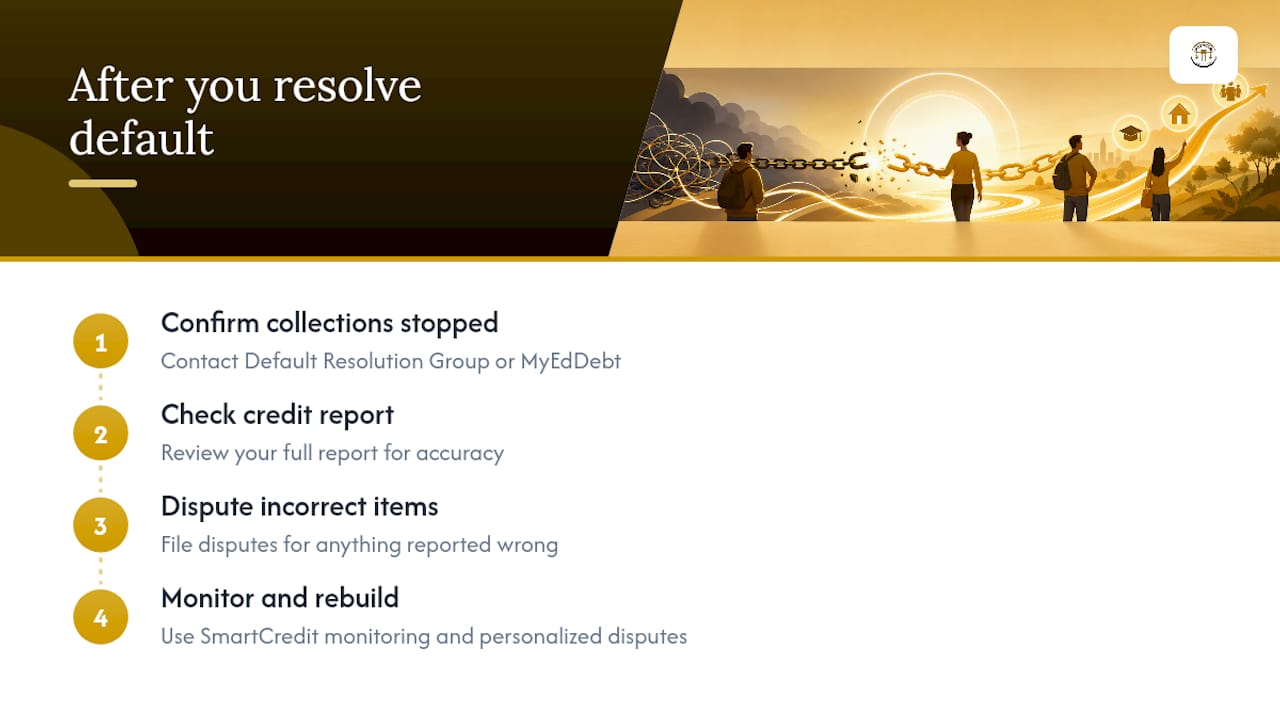
Stopping collections is the fire you put out first. Once your loan is out of default, whether through rehabilitation, consolidation, or a repayment agreement, the next job is repairing what default did to your credit file, since collections and missed payments typically stay visible for years even after the underlying account is resolved.
That's where checking your full credit report for accuracy, disputing anything reported incorrectly, and tracking your score over time matters. Pioneercreditsolution works with clients on exactly this kind of recovery, using SmartCredit monitoring alongside personalized dispute strategies to address negative items once the immediate crisis is handled. None of that replaces the official ED steps above. Contact the Default Resolution Group or MyEdDebt first. Credit rebuilding is what you do once collections are actually paused, not instead of it.
— Danny
How Pioneercreditsolution Can Help After You've Stopped Collections
Once you've contacted the Default Resolution Group or started rehabilitation through MyEdDebt, the default itself is being handled. What's often left behind is the credit damage: the default notation, related late payments, and any collection accounts still sitting on your report.

Pioneercreditsolution is the option for that next stage, not a substitute for the official ED process. We specialize in identifying inaccurate or outdated items on your credit report and disputing them directly, using SmartCredit monitoring to track every change as it happens. Some clients have reported score increases after old collection items and errors get corrected. If you've already made your first payment or started rehab and want to know what your credit file will need next, start with a free consultation or look at our full credit repair services to see how the rebuilding process works.
Sources
- Collections on Defaulted Loans – Federal Student Aid
- U.S. Department of Education to Begin Federal Student Loan Collections, Other Actions to Help Borrowers Get Back into Repayment
- What should I do when a debt collector contacts me? – CFPB
- MyEdDebt - Debt resolution portal for borrowers
FAQ
What Is the Trump Administration Doing With Student Loans?
The Department of Education resumed federal student loan collections on May 5, 2025, restarting administrative wage garnishment and Treasury offsets for defaulted borrowers after years of pandemic-related pauses. Outreach notices and Income-Driven Repayment processing improvements accompanied the restart.
Do Unpaid Student Loans Go Away After Seven Years?
No. Federal student loan debt has no statute of limitations, so the government's administrative collection powers continue until the balance is paid or the default is resolved through rehabilitation, consolidation, or discharge. Private loans may follow state statute of limitations rules for lawsuits, but that doesn't erase the debt itself.
Will Student Loans Be Garnished in 2026?
Yes, for borrowers still in default. Administrative wage garnishment can withhold up to 15% of disposable pay, and Treasury offsets against tax refunds continue as part of the collections resumption that began in 2025. Acting within the 30 day AWG notice window or the 65 day Treasury offset window is the way to stop it before it starts.
What Happens If I Never Pay My Student Loan Debt?
Your loan stays in default indefinitely, and the government can continue garnishing wages, seizing tax refunds, and in limited cases offsetting Social Security payments until the debt is resolved. Default also blocks access to new federal financial aid and further student loan forgiveness programs, and it stays on your credit report, making it harder to qualify for a mortgage, auto loan, or business financing until it's addressed.
Should I Pay Collections in Full or Settle?
Paying in full stops collections immediately and avoids any lingering default notation issues, but it isn't realistic for everyone. Rehabilitation or consolidation often makes more sense if a lump payment isn't possible, since both restore good standing without requiring the entire balance upfront.