
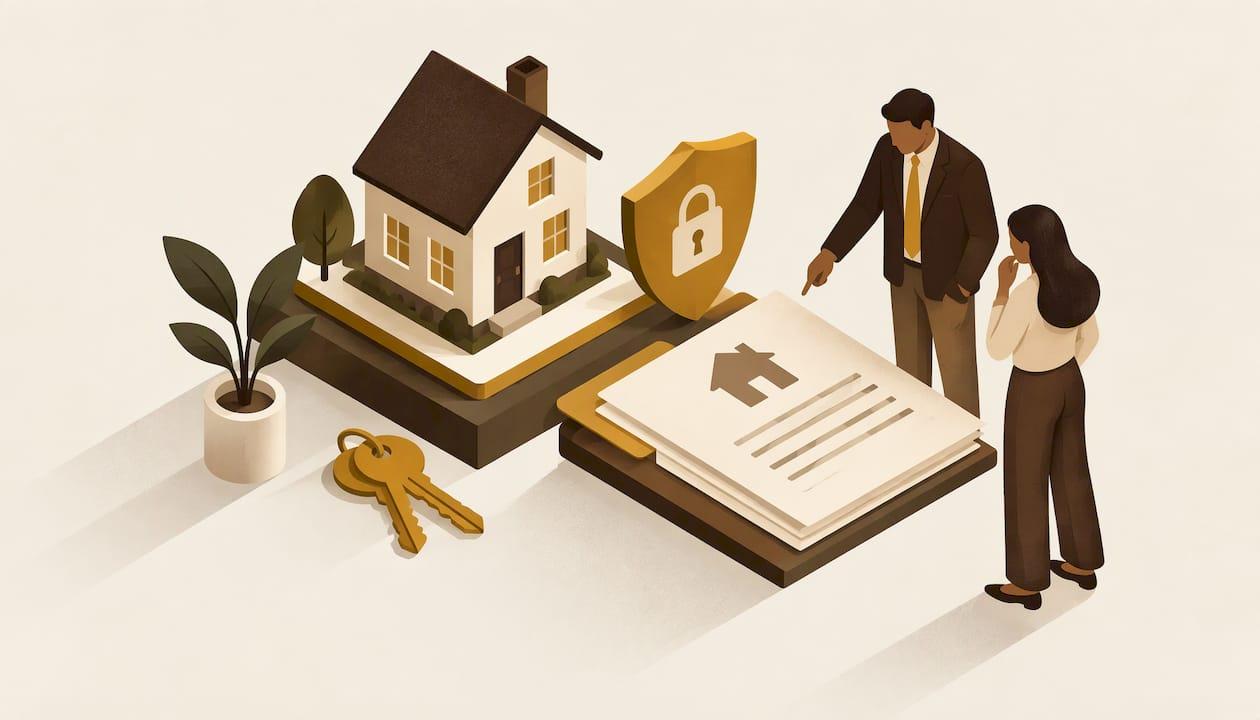
The best protection against home title fraud is a mix of habits: watch your county land records, keep your mail and mortgage statements under review, keep a close eye on your credit, and know what title insurance does and does not cover. No single product locks your deed. What works is catching a forged filing early and acting fast. This guide covers how deed theft happens, how to spot it, how to protect your title, and what to do if someone has already filed a fake deed.
TL;DR
- Title fraud happens when someone records a forged deed with your county recorder, often using stolen identity details, so it looks like you transferred your home.
- Vacant homes, land and homes with no mortgage are common targets, but any owner can be hit.
- Alerts and monitoring services notify you after a filing. They do not stop a deed from being recorded.
- Check your records, protect your mail, review your credit, and ask your county about a free recording alert.
- If you suspect fraud, call your county recorder, the police, a real estate attorney and your title insurer right away, then freeze your credit.
Table of Contents
- What home title fraud is and how it works
- How common is home title theft?
- Warning signs someone is targeting your title
- Practical steps that lower your risk
- Alerts and monitoring services: what they can and cannot do
- What title insurance covers
- If you think your title has been stolen
- Get help cleaning up your credit after fraud
- FAQ
- Sources
What home title fraud is and how it works
Title fraud, also called deed theft, is when someone illegally transfers the title or deed of your property without your knowledge. According to the National Association of Realtors, a scammer might forge your signature, use a fake ID and file the deed with the local recorder's office, so it looks as if you willingly transferred the property. If nobody catches it, it can lead to foreclosure or eviction even while you still live in the home.
California's Department of Financial Protection and Innovation describes the usual stages:
- Identity theft. The thief gathers your name, address and Social Security number.
- Forgery. A deed is created that moves the property to the scammer or a shell company.
- Recording. The fake deed is filed with the county recorder.
- Cashing in. The thief takes out home equity loans, rents the home or sells it.
The notary is often the weak point. The Texas Land Title Association notes that fraudsters usually ask for the deal to be handled remotely so they never appear at the title company. They then conspire with a notary, trick one with a fake ID, or reproduce a notary's seal and signature so the document looks valid on its face.
Three common patterns
The FBI's Boston Division points to three patterns in quit claim deed fraud:
- Scammers who search public records for vacant parcels and properties with no mortgage or lien, then impersonate the owner.
- Family members, often targeting elderly relatives, who pressure them to transfer property.
- "Title pirates" who use fraudulent or forged deeds to convey title.
That last point matters for prevention. Much of the risk comes from information that is public or easy to steal: who owns a property, whether there is a loan on it, and your personal identifiers.

How common is home title theft?
It is a real crime, but the numbers are hard to pin down. The FBI says its Internet Crime Complaint Center has no statistics solely for quit claim deed fraud. It does report that from 2019 through 2023, 58,141 victims nationwide reported $1.3 billion in losses tied to real estate fraud, a broader category than deed theft.
The trend is upward. The American Land Title Association reports, citing the FBI's 2025 IC3 report, that real estate fraud losses reached $275.1 million in 2025, up from about $173 million in 2024, with 12,368 complaints filed in 2025.
Experts disagree on how widespread deed theft is. The president of the Identity Theft Resource Center told Washington Consumers' Checkbook that home title identity theft does occur but is not that common and is not the biggest threat to our identities. A retired FBI agent speaking for a monitoring company said in the same article that it is far more prevalent than statistics show. The honest takeaway: the odds for any one owner are low, the damage when it happens is severe, and several low-cost habits cut the risk further.

Warning signs someone is targeting your title
Watch for these:
- You stop receiving property tax bills.
- You get mail addressed to someone else at your address.
- You receive unexpected notices from banks or government offices.
Those signs come from the NAR consumer guide, which also lists red flags for buyers: a seller offering a vacant property well below market value, a seller who communicates only electronically and avoids phone or video calls, or one who insists on using their own remote notary to close.
The quietest cases are the worst. The Texas Land Title Association says many owners do not learn of a fraudulent deed or lien until they try to sell or refinance and the title search turns up the forged documents. That is why checking records on a schedule matters more than waiting for a sign.
Practical steps that lower your risk
The NAR guide lists the core habits. Here they are in order of effort, with how to put each into practice.
- Look up your own record. The Federal Trade Commission notes you can check your title for free with your state's land records office. Search your name and address on the county recorder's website a couple of times a year. Put a reminder in your calendar.
- Ask about a recording alert. Some counties notify owners when a document is recorded under their name. The FTC says some areas offer free notification programs. Call your recorder's office and ask.
- Protect your mail. Put mail on hold with USPS for extended trips and shred documents that carry personal information.
- Do not leave the property unattended for long stretches. Vacant homes and land are common targets. If you own a rental or vacant lot, check its record more often.
- Review bank and mortgage statements. Unfamiliar liens or loan activity are early evidence.
- Monitor your credit. A new mortgage or lender you do not recognize can be the first visible sign. You can pull reports and watch for changes.
- Be careful with notaries and remote closings. If you are selling, use a title company and a notary you chose. If you are buying, be wary of the red flags above.
Credit monitoring as an early tripwire
A forged deed is often followed by borrowing against your equity. Those loans leave marks on your credit file. Monitoring your reports will not stop a recording, but it can show an unfamiliar mortgage or lender sooner than a county search would. Pairing it with a freeze on your credit files makes new borrowing in your name harder. If you want help reading your reports or acting on what you find, our credit repair services start with a review of your credit profile.

Alerts and monitoring services: what they can and cannot do
This is where most owners get confused. Services marketed as "title lock" or deed monitoring watch public records and notify you. They do not block anything.
The FTC put it plainly in August 2024: title lock insurance is not title insurance, it is not insurance at all, and the service would only tell you after your title was transferred without your authorization.
The Maryland Insurance Administration agrees: deed fraud monitoring services are not insurance and cannot stop someone from filing a fraudulent document against your property. If a change is fraudulent, you still need to take legal steps to correct your records.
Government alert programs have the same limit, and that is by design. Multnomah County, Oregon says its Property Recording Alert Service gives early notification but is not a guarantee against fraud and does not prevent documents from being recorded, because state law requires a document that meets statutory requirements to be recorded.
So think of alerts as a smoke detector, not a fire door. Their value is speed: the sooner you hear about a filing, the sooner you can start the correction. A free county alert does that job at no cost, which is why asking your recorder comes first. If you consider a paid service, read what it promises and what it actually does. California's DFPI advises reading the fine print, since some offer real peace of mind while others simply send alerts.
What title insurance covers
Title insurance is the one product that responds financially to fraud claims. According to NAR, it protects against title problems, including fraudulent claims on a home, with legal defense and loss coverage if someone else claims to own your property because of a forged deed.
The timing matters. A standard ALTA owner's policy covers loss from a title defect caused by forgery, fraud, duress, incompetency, incapacity or impersonation. The policy form also excludes matters that attach or are created after the date of the policy, with limited exceptions. In plain terms, it is strongest against a forgery in your home's past, such as a bad deed earlier in the chain of ownership.
Fraud that happens after you buy is less certain. California's DFPI notes that traditional owner's coverage does not cover fraud after you buy. A Washington and Lee Law Review article by Stewart Sterk explains that the enhanced homeowner's policy does protect against post-policy forgery, but if the owner actually signed a deed to a fraudster, an exclusion for defects the insured created or agreed to would apply.
What to do with that:
- When you buy, buy an owner's policy, read it, and ask the agent what is covered after closing.
- Ask whether an enhanced or homeowner's version is available for your property.
- Keep your policy where you can find it. You will need it to file a claim.
If you think your title has been stolen
Act the same day. The steps below combine NAR's guidance and California DFPI's list:
- Contact your county recorder. Request a copy of the recorded deed to confirm what was filed.
- File a police report.
- Report to the FBI's Internet Crime Complaint Center and file an identity theft report with the FTC.
- Talk to a real estate attorney as soon as possible. Correcting the record is a legal process.
- Notify your title insurance company if you have a policy.
- Freeze your credit with Experian, Equifax and TransUnion, and consider a fraud alert.
- In California, DFPI also lists notifying the Attorney General's Office and filing a complaint with the Department of Real Estate.
Because deed theft usually starts with stolen identity details, the credit side needs cleanup too. Our guide to identity theft recovery, FTC steps and a yearlong fraud alert walks through that process.
Our perspective
Most people think of a deed as paperwork that sits in a drawer. In our work with clients, we see that a home is usually tied to the rest of their financial life: the mortgage, the equity, the credit file, the plans for the family. When identity details are stolen, the damage rarely stays in one place.
That is why we treat title protection as part of credit health. Review your credit reports on a regular schedule, freeze your files when you do not need new credit, and dispute anything that is not yours. If a fraudulent loan lands on your file, getting it corrected quickly protects your score and your ability to borrow for a home, a car or a business.
We built Pioneer Credit Solution to take people from recovery to growth, and protecting what you have already built is part of that path. Our credit profile analysis and credit monitoring are designed to help you see problems early and act on them with a plan.
Yvette V.
Get help cleaning up your credit after fraud
A stolen identity can leave unfamiliar accounts, inquiries or loans on your reports. We help individuals review their credit profile, address negative items and put a plan in place to rebuild, and our credit monitoring is designed to keep you informed as your reports change. Start with our credit repair services or see everything we offer on our home page.

If you are planning to buy or refinance, a clean credit file and a verified title record make the process smoother. Get Your Free Consultation and we will talk through your situation.
FAQ
What is the best way to protect my home title from being stolen?
There is no single lock, so layer your defenses. Check your county records for your name and address, ask your recorder about a free recording alert, protect your mail, and monitor your credit. Keep a valid title insurance policy and know what it covers.
How common is home title theft?
It is real but hard to measure. The FBI has no figure just for deed fraud, though it reported 12,368 real estate fraud complaints in 2025 according to ALTA. Experts disagree on how often it happens, so treat it as a low-probability, high-damage risk and take the inexpensive precautions.
Is a home title lock service worth it?
Know what you are buying. The FTC says these services are not insurance and only notify you after your title has been transferred. If you want notifications, ask your county recorder first, since some offer them free, and read any paid service's terms closely.
How can I tell if someone is trying to steal my title?
Common signs include property tax bills that stop arriving, mail for someone else at your address, and unexpected notices from banks or government offices. An unfamiliar mortgage or lender on your credit report is another signal. Checking your county records a few times a year can catch a filing before those signs appear.
What should I do first if I think my deed was forged?
Contact your county recorder for a copy of the recorded document, then file a police report and speak with a real estate attorney. Notify your title insurer, report to the FBI's IC3 and the FTC, and freeze your credit with all three bureaus.
Sources
- NAR Consumer Guide: Understanding and Protecting Yourself From Title Fraud
- California DFPI: Home Title Fraud
- Texas Land Title Association: Deed Fraud
- FBI Boston: Quit Claim Deed Fraud Is on the Rise
- ALTA: FBI Cybercrime Report and Real Estate Fraud Losses
- Washington Consumers' Checkbook: Home Title Monitoring Services
- FTC Consumer Alert: Home title lock insurance
- Maryland Insurance Administration: Deed and Title Fraud
- Multnomah County: Property Recording Alert Service
- ALTA Owner's Policy form
- Washington and Lee Law Review Online: Stewart Sterk