
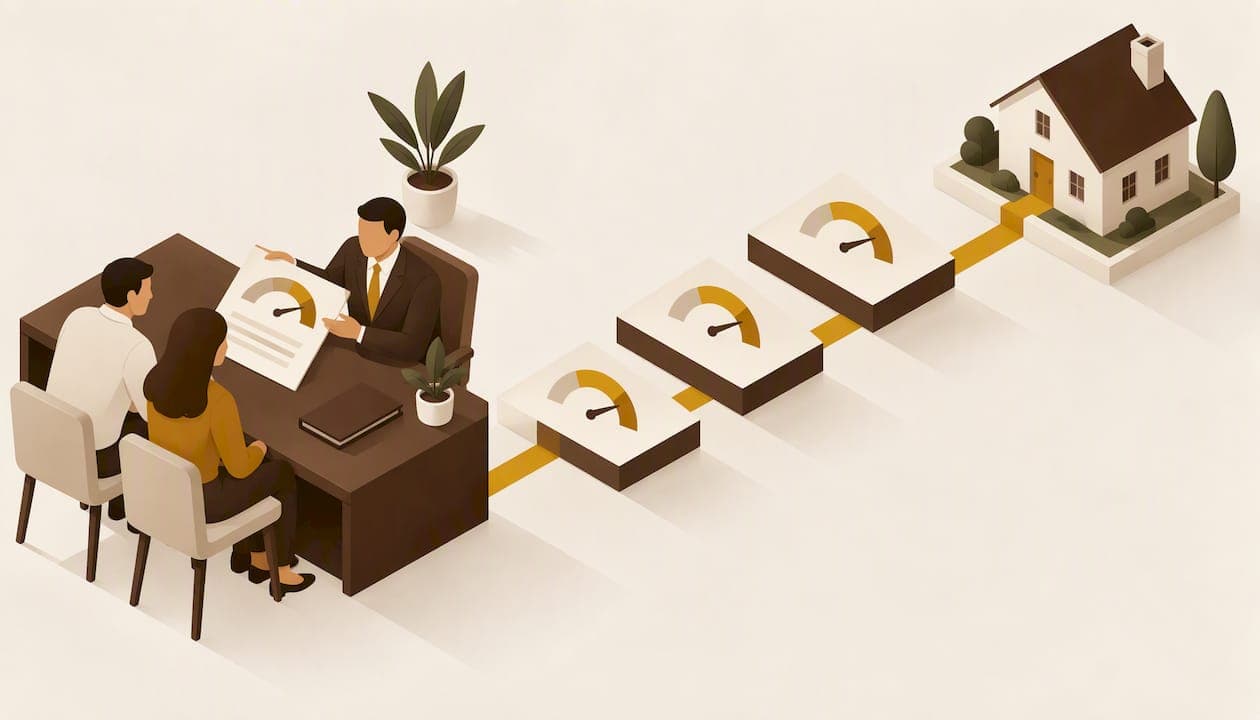
The minimum FHA credit score is 580 if you want to put down as little as 3.5%. With a score from 500 through 579, you can still qualify, but HUD's borrower eligibility rules cap the loan at 90% of the home's value, which generally means at least 10% down. Below 500, FHA-insured financing is not available.
Those numbers are the starting line, not a promise. Your lender decides which score counts, checks the rest of your file, and may ask for more than FHA does. Below, you will see how the scores work, what else gets reviewed (including collections), and how to use the months before you apply.
TL;DR
- 580 or higher: eligible for maximum FHA financing, commonly paired with a 3.5% down payment.
- 500 to 579: eligible with a maximum 90% loan-to-value, so plan on at least 10% down.
- Under 500: not eligible for an FHA-insured loan.
- The score that counts is your FHA decision score from the lender's reports, not necessarily the number in a free app.
- Score is one factor. Debt, income, assets, collections and payment history all matter, and lenders can set stricter rules than FHA.
Table of Contents
- The FHA credit score cutoffs at a glance
- Why the 500 to 579 range is harder than it looks
- Which score does the lender actually use?
- What else FHA underwriters review
- Are you really ready? A worked example
- How to prepare in the months before you apply
- Is FHA the cheapest route?
- Our perspective: treat the score as a project, not a number
- Work with a team that can take you from credit repair to the keys
- FAQ
- Sources
The FHA credit score cutoffs at a glance
| Decision score | What FHA allows | What it usually means for you |
|---|---|---|
| 580 or higher | Maximum financing | Down payment as low as 3.5% |
| 500 to 579 | Maximum 90% loan-to-value | At least 10% down, plus closing costs |
| Below 500 | Not eligible | Rebuild credit before applying |
These bands come from the HUD borrower eligibility section. The CFPB adds that FHA loans are made by private lenders and insured by the Federal Housing Administration. They allow down payments as low as 3.5% and generally accept lower scores than conventional loans. Every FHA loan requires mortgage insurance.
That last point is where many buyers get surprised. FHA does not lend money. Your lender does, and the insurance cost is passed on to you.
Why the 500 to 579 range is harder than it looks
On paper, a 540 score qualifies. In practice, many lenders set their own minimums above FHA's. These are called lender overlays. HUD's Handbook 4000.1 is the policy source FHA-approved lenders follow, but it does not stop a lender from asking for more. So a lender that says "we need 620" is not misquoting FHA. It is describing its own risk rules.
If your score sits in the 500s, expect three things:
- You will need a larger down payment, at least 10%.
- You may need to shop several lenders to find one that works with your score.
- The rest of your file has to be stronger, because there is less room for error.
The CFPB's homebuying guidance says borrowers below 620 generally have trouble qualifying for a mortgage and may want to improve their credit first. It also says FHA, VA and USDA programs may be options for some borrowers in the 620 to 680 range, especially with smaller down payments.
Which score does the lender actually use?
This is the most overlooked piece of the FHA credit score question. The number on your banking app is probably not the number your lender pulls.
Per HUD's guidance, FHA uses a decision score taken from the three credit bureaus:
- Three scores: the middle score is used.
- Two scores: the lower score is used.
- One score: that score is used.
- Multiple borrowers: the lowest borrower decision score can control.
The CFPB notes that mortgage lenders commonly review reports from Equifax, Experian and TransUnion, and that credit score is only one factor. Lenders also look at your credit report, existing debt, savings and assets, and income.
If you are buying with a spouse or partner, their lower score can drive the decision. Look at both files before you start house hunting.
A better question to ask a loan officer than "What is my score?" is: "What is my FHA decision score under your report and model?" Then ask which report date it comes from.
New score models are on the way
HUD has published a preparedness guide for alternative credit scores. It states that the 500, 580 and 620 thresholds still apply to the new models. It references January 1, 2027 as the implementation date for the transition. Until then, lenders keep using existing Handbook 4000.1 guidance. Because timing and lender adoption can vary, confirm which model your lender uses instead of trusting an older article.

What else FHA underwriters review
A 580 gets you through one door. These are the others.
- Payment history. Recent late payments hurt more than old ones.
- Debt-to-income ratio. Monthly debts compared to monthly income.
- Assets. Down payment, closing costs and reserves.
- Credit report details. Collections, judgments, and accounts in dispute.
- Property. The home must meet FHA standards.
The CFPB makes the same point: an applicant can meet a score threshold and still be denied because of debt, income, assets or payment history. A score alone does not decide it.
Collections and the $2,000 threshold
Buyers often ask about FHA collections guidelines. FHA does not require every collection to be paid off. According to HUD's FHA answers page, when the credit reports show cumulative outstanding collection balances of $2,000 or more, the lender must do one of three things:
- Verify the debt is paid in full at or before settlement, using an acceptable source of funds.
- Verify you have a payment arrangement with the creditor and include that monthly payment in your debt-to-income ratio.
- If no arrangement is available, count 5% of each outstanding collection balance as a monthly payment in your debt-to-income ratio.
The same page says the lender must document its reasons for approving a loan when you have collection accounts, and you must provide a letter of explanation with documentation for each outstanding one. We walk through this in more detail in our guide to getting a mortgage with collections.
Are you really ready? A worked example
Say a buyer has a 572 decision score, $3,400 in collections and a $300,000 target purchase. This is an illustration, not a quote.
- At 572, the loan is capped at 90% loan-to-value. That is at least $30,000 down on a $300,000 home, before closing costs.
- With $3,400 in collections, the lender needs to see payoff, a payment plan, or a 5% calculation. The 5% rule would add $170 a month to the buyer's debts when figuring the debt ratio.
- Raising the score to 580 or above changes the down payment picture. The loan can then be maximum financing, commonly with 3.5% down. That would be $10,500 on the same price, though the lender's full quote sets the real terms.
A gap of eight points can mean roughly $19,500 less cash at the table in this example. That is why the last stretch of score improvement is worth real effort. The cash is only part of the picture. The CFPB reminds buyers to budget for closing costs, points if applicable, moving expenses and immediate repairs.

How to prepare in the months before you apply
If your purchase is at least six months away, the CFPB recommends paying every bill on time and paying down credit card debt. It cautions against taking a car loan, making large card purchases or opening new cards before you buy.
Here is a practical order of operations:
- Pull your reports. Checking your own credit report does not hurt your score. Read every account for errors.
- Dispute what is wrong. Correcting report errors well before application can prevent an avoidable denial or higher pricing.
- Lower card balances. See our guide on getting utilization under 30%.
- Freeze new credit. No new cards, no financing a car, no big purchases.
- Handle collections on purpose. Decide whether to pay, arrange payment or document, based on the rules above.
- Ask for a rapid rescore once you have paid down balances or fixed errors. Our explainer on rapid rescore covers how it works.
- Compare Loan Estimates. Request them from more than one lender.
If you are coming out of bankruptcy, start with how to rebuild credit after bankruptcy. If your file is thin, see how to fix a thin credit file in 90 days. HUD's alternative score guidance says buyers with limited traditional credit are not automatically excluded, though credit report requirements remain in place.
For the bigger picture on how lenders read your numbers, read our mortgage credit score guide.
Is FHA the cheapest route?
Not always. The CFPB says FHA can often be less expensive for lower scores or smaller down payments. For borrowers with good credit and a 10% to 15% down payment, an FHA loan may cost more than a conventional one because of mortgage insurance. Ask for Loan Estimates for both loan types and compare the upfront and monthly costs side by side.
Our perspective: treat the score as a project, not a number
At Pioneer Credit Solution, we see the same pattern with buyers who ask about FHA. They find the 580 figure, check a free app, and either feel shut out or assume they are fine. Both reactions can be wrong. The right move is to find out what your lenders will see, then close the gap on purpose.

We look at the whole file. A credit profile analysis shows which negative items are holding the score down, and which ones may also affect debt ratios. Our work is to address and resolve negative report items and then support you as you move toward a home, car or business loan. Many clients report score increases of over 120 points, though results vary by file and we cannot promise any specific outcome.
Our advice is simple. Do not apply the day you hit 580. Give the score some breathing room, keep balances low, and let the lender's numbers be the final check. A rejected application does not help your goal, and a few extra months of preparation can change the terms you get.
— Yvette V.
Work with a team that can take you from credit repair to the keys
If negative items are keeping you below the line, our credit repair services target the errors and unresolved accounts on your reports. If you also need financing help once your score is ready, our financing page lists the personal, business and auto loan options we can match you with, and we also offer home buying assistance. Get your free consultation and start with a clear picture of where you stand.
FAQ
Can I buy a house with a 580 credit score?
Yes, 580 meets FHA's threshold for maximum financing, commonly with a 3.5% down payment. You still need to pass underwriting on income, debts, assets and credit history. Some lenders also require a higher score than FHA does, so ask each one about its minimum.
What is the lowest credit score for an FHA loan?
The lowest score eligible under HUD's rules is 500, and only with a maximum 90% loan-to-value, so about 10% down. Below 500 is not eligible. Finding a lender willing to approve a score that low can be difficult.
Do I have to pay off collections to get an FHA loan?
Not necessarily. When cumulative collections reach $2,000 or more, the lender must verify payoff, a payment arrangement counted in your debt ratio, or a 5% monthly calculation of the balance. You also need to provide a letter of explanation for each outstanding collection.
Why is my FHA score different from my app score?
FHA uses a decision score based on the three bureaus, taking the middle of three scores or the lower of two. Apps often show a single bureau or a different scoring model. Ask your lender which model and report date it will use.
Does checking my own credit hurt my score?
No. According to the CFPB, checking your own credit report does not hurt your score. Applying for new credit shortly before underwriting can, so hold off on new accounts.
Sources
- HUD: Section A, Borrower Eligibility Requirements
- HUD: FHA Single Family Housing Policy Handbook 4000.1
- HUD: FHA Alternative Credit Scores Preparedness Guide
- HUD: Does FHA require collections to be paid off?
- CFPB: FHA loans
- CFPB: Does my credit score affect my ability to get a mortgage?
- CFPB: Get your money situation in order
- CFPB: What kind of down payment do I need?