
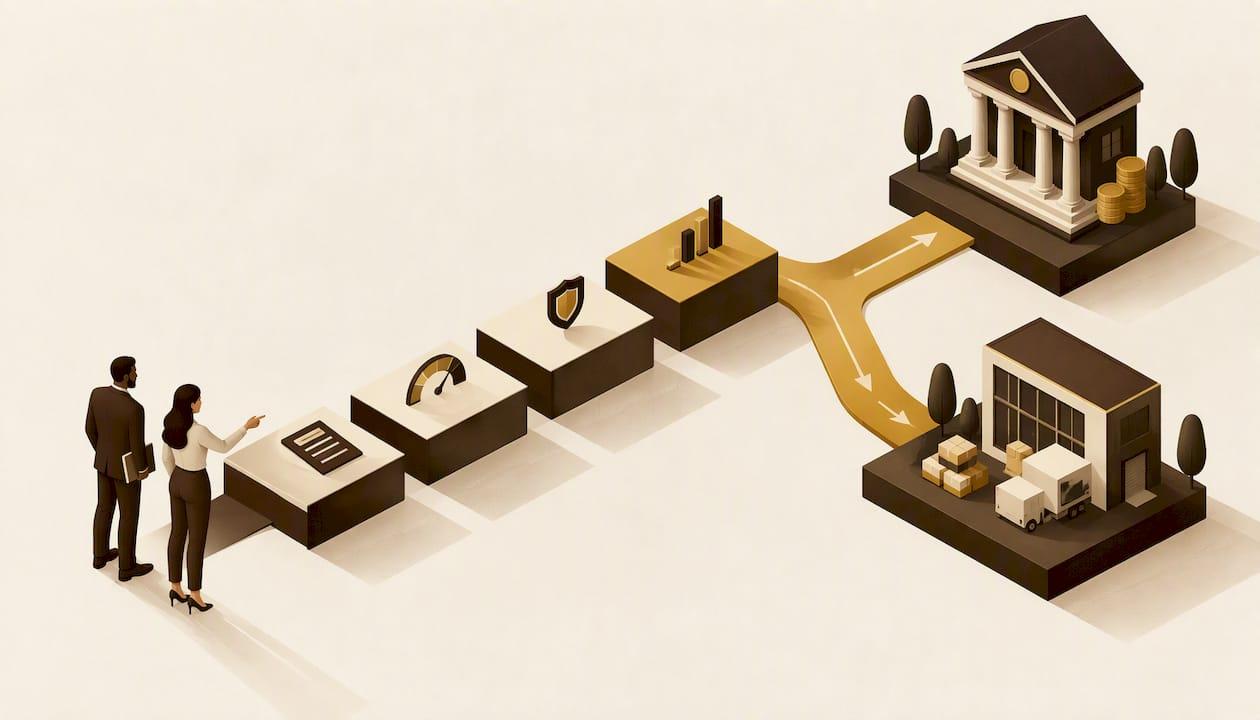
Business credit tiers are the stages most owners move through as they build funding: Tier 1 starter trade accounts, Tier 2 larger store and supplier accounts, Tier 3 bank and lender financing, and Tier 4 outside investors. They are not official score bands. No bureau publishes a rule that says "Tier 2 starts here." The tiers are a working map, and this guide shows what each stage means, what to verify at each step, and how to move up without skipping the groundwork.
TL;DR
- "Business credit tiers" usually describes a ladder of financing: starter trade credit, advanced trade credit, bank lending, then investors. It is not an official score scale.
- Tier labels for vendors and auto lenders have no uniform meaning. They vary by lender, so always ask what a provider actually reports.
- Start with the foundation: a separate legal entity, an EIN and a business bank account, as the SBA advises.
- Tier 1 only helps if the vendor reports your payments to a business credit bureau. Confirm that before you open the account.
- Each tier builds the track record the next tier looks for. Rushing to Tier 3 without Tier 1 and 2 history is the most common reason for a denial.
Table of Contents
- What business credit tiers actually mean
- The four tiers at a glance
- Before Tier 1: the foundation
- Tier 1: starter trade credit
- Tier 2: advanced trade credit
- Tier 3: bank and lender financing
- Tier 4: investors
- Business scores are not personal score tiers
- How to check and monitor your reports
- Perspective: why we build the ladder before the loan
- Where we can help
- FAQ
- Sources
What business credit tiers actually mean
Search for this topic and you will see two different ideas sharing one word.
The first is the financing ladder. Here a tier is a type of credit you can reach at a given stage of your business. This is the meaning most business owners care about, and it is the one this article follows.
The second is a score tier: a band of scores that a lender or bureau groups together. Consumer and auto lenders use these a lot. According to Business.org, auto lenders commonly sort borrowers into tiers based mostly on credit scores to decide qualification and rates, and those tiers have no official meaning and differ from lender to lender. The same is true of vendor tiers in the business world. A "Tier 1 vendor" is a label from the credit-building community, not a designation from a regulator.
That matters because it changes what you should do. Do not ask whether a vendor is "really" Tier 2. Ask what it extends, what it requires, and whether it reports.

The ladder idea does line up with how the industry thinks. Dun & Bradstreet frames business credit as a journey in which financing needs and creditworthiness assessments change as a business grows. The FDIC makes a similar point: for many businesses, personal and business credit sit on a spectrum, and owners progress from relying on personal credit toward business credit as they grow in age, size and sophistication.
The four tiers at a glance
| Tier | What it is | Typical examples | What it needs |
|---|---|---|---|
| Tier 1 | Starter trade credit | Net-30 accounts with suppliers | Entity, EIN, business bank account, phone and address |
| Tier 2 | Advanced trade credit | Store and supplier accounts with higher limits | Several months of reported on-time payments |
| Tier 3 | Bank and lender financing | Business credit cards, lines of credit, term loans, SBA loans | Credit history, revenue, often collateral or a guarantee |
| Tier 4 | Outside investors | Angel investors, venture capital | A business case, traction and a willingness to share ownership |
The pattern is simple: each tier is larger, cheaper per dollar borrowed, and harder to get than the one before. Tier 4 is different in kind because it trades ownership for money rather than lending it.
Before Tier 1: the foundation
No tier works well on a weak base. The SBA says building business credit involves setting up a separate legal entity, getting a federal EIN and opening a dedicated business bank account. It also explains that a business bank account separates personal and business finances and gives lenders data they use during a funding review.
In practice, your checklist looks like this:
- Form the business (LLC or corporation) and register it in your state.
- Get an EIN from the IRS.
- Open a business checking account in the exact legal name.
- Use a consistent business name, address and phone number everywhere.
- Create your Dun & Bradstreet profile and D-U-N-S Number.
If you are working through this without a Social Security number on applications, our guide to building business credit with an EIN walks through the steps. LLC owners can follow our 30 to 90 day LLC roadmap, and brand-new companies will find the startup business credit roadmap useful.

Tier 1: starter trade credit
Tier 1 is where most businesses begin. Trade credit lets you buy goods or services from a supplier and pay later. Net 30 means payment is due within 30 days.
The SBA notes that vendor credit can conserve cash flow and establish a payment history with the vendor. If you cannot qualify for net-30 terms, the same SBA page says you can ask suppliers for shorter terms such as net-20 or net-10. That is a legitimate way in.
What makes a Tier 1 vendor useful
A Tier 1 vendor is useful for credit building only if it meets four tests:
- It approves new businesses without requiring years in business or a personal guarantee in every case.
- It reports payments to at least one business credit bureau, ideally more than one.
- It reports positive history, meaning on-time payments, and you understand it will also report late ones.
- You would buy from it anyway, such as shipping, office or industrial supplies you already use.
Office, packaging and industrial supply companies are the usual names that show up in net-30 roundups. Terms and reporting practices change, so check the vendor's current application page and ask directly which bureaus it reports to before you spend a dollar.
There is a real caution here. A Federal Trade Commission complaint documents that many supplier payment experiences go unreported, and reported commercial payment information can be incomplete or inaccurate. So paying on time is necessary, but you also need to confirm that the payment actually appears on your report. We cover the process in detail in our guide to net 30 accounts that report.
How many accounts, and how long
There is no official number. A practical target is three to five trade accounts that report, paid on or before the due date. Paying early is often the better habit: it shows up as a stronger payment record on some scoring models, and it costs nothing. If you want a realistic timeline for an EIN-only business, see our breakdown of building EIN-only business credit over one to two years.
Tier 2: advanced trade credit
Tier 2 looks like Tier 1 with higher stakes. These are larger suppliers, store accounts and fleet or retail revolving accounts that extend bigger limits and often want to see an existing track record. Some will check your business profile first and ask for references or trade accounts already on file.
How you know you are ready:
- Your Tier 1 accounts have reported on-time payments for a few months.
- Your D&B, Experian and Equifax business files exist and the details match.
- Your business bank account shows steady deposits.
Be skeptical of the exact labels. Where one article calls a store card "Tier 2," another may call it "Tier 3." Use the label only as a rough guide. What matters is the offer: the limit, the terms, whether there is a personal guarantee, and which bureaus see the payments.
Using nontraditional data
If your history is thin, nontraditional information can sometimes help. The FDIC explains that alternative data may be used to assess credit risk for people and businesses with limited history, with utility, phone and rent payments as personal-credit examples. This is not a substitute for trade accounts, but it shows lenders are looking beyond a single score.
Tier 3: bank and lender financing
Tier 3 is where "business credit tiers" gets confusing, because the same words get used for two things. Some credit-building guides use "Tier 3" for business credit cards and revolving accounts from major issuers. Financing guides use "Tier 3" for bank lending: term loans, lines of credit and SBA-backed loans. The two overlap, and neither is an official standard.

A useful way to cut through it: in either case, Tier 3 is the first stage where a lender evaluates the whole business, not just your payment history with a vendor. The SBA's own research treats banks, online lenders, finance companies and trade credit as distinct parts of the small-business credit market, which is a good reminder that Tier 3 is a group of lender types, each with its own rules.
What Tier 3 lenders usually look at:
- Your business credit reports and scores, which are separate from your personal credit scores.
- Your personal credit, especially for newer businesses.
- Revenue, time in business and cash flow.
- Collateral. The SBA defines collateral as an asset used to secure business credit or a loan, which can be tangible or intangible.
Choosing between a secured and an unsecured product has real consequences for your assets. Our guide on secured vs unsecured loans explains the tradeoff, and our SBA loan requirements checklist shows what lenders inspect.
One more cost to understand before you borrow: what happens if you fall behind. Late payments can bring penalty interest on top of the regular rate, and a short explainer on late-payment interest on loans shows how that kind of charge is calculated in principle. Always check your own loan agreement for how your lender applies it.
Personal credit still matters here
Many owners are surprised that Tier 3 reaches back to their personal file. For a young company, lenders often treat the owner's personal history as part of the picture. If your personal score is holding back your business funding, fixing that comes first. Our credit repair services are built for that situation.
Tier 4: investors
Tier 4 is not credit. Investors give you capital in exchange for equity or a share of future returns. It makes sense when your growth needs are bigger than a lender will underwrite, or when your business model carries more risk than debt can handle. It also costs you something no loan does: ownership and, often, some control.
Most small businesses never need Tier 4, and that is fine. A well-built Tier 1 to Tier 3 profile can fund a lot of growth without giving up equity.
Business scores are not personal score tiers
A frequent point of confusion: people searching for tiers often want the "five tiers of credit scores," which is a consumer idea. Consumer score bands (for example poor, fair, good, very good, exceptional) apply to personal FICO and similar scores. Business scores are separate. The SBA explains that business credit scores represent the business's own risk, apart from personal scores, and Experian says they use a different numerical range.
The scales also differ from bureau to bureau. Dun & Bradstreet's PAYDEX runs from 0 to 100, and Experian's business score uses a 0 to 100 scale where higher means lower risk. Do not compare numbers across bureaus as if they were the same scale. Our comparison of D&B vs Experian explains how the two differ in what lenders see.
At the consumer end, the three big bureaus dominate. In 2024 the CFPB director noted that Equifax, Experian and TransUnion dominate consumer credit reporting. If you also want to understand how personal scoring models affect your rates, read about FICO 8 vs 9.
How to check and monitor your reports
You cannot manage what you do not see. The FDIC advises that businesses can check their reports through the major bureaus (Dun & Bradstreet, Experian and Equifax) or through monitoring services, review them regularly for accuracy, dispute errors and confirm that payment activity is reflected.
A simple routine:
- After you open each trade account, check each bureau after 30 to 60 days to see whether the payment appears.
- Compare the company name, address, phone number and EIN across all files.
- Dispute errors in writing with the bureau and keep copies.
- Review your reports before every major credit application.
Perspective: why we build the ladder before the loan
We see the same pattern again and again. A founder with a strong idea applies for a loan or a credit card, gets denied, and concludes that business credit is out of reach. The real problem is almost always sequence. The business has no reporting history, the personal file has a few unresolved items, and the application asks a lender to take a leap.
Our view is that the tiers are best treated as a plan, not a label. Fix the personal file if it needs fixing. Form the entity properly. Open reporting trade accounts you will actually use. Check that they show up. Then, and only then, apply for the financing that matches where you really are.
That is why we handle credit repair, business formation, business credit building and loan matching in one place. Each step sets up the next, and you do not have to coordinate four different providers. We cannot promise a particular score or approval, and nobody honestly can, but a clear order of operations improves your odds and saves you from wasted applications.
— Yvette V.
Where we can help
If you are mapping out your own tiers, we can take the heavy lifting off your plate. Our business credit building service helps you set up the foundation and work toward reporting accounts. If your personal credit is the obstacle, we can start with a credit profile analysis and a plan to address negative items. When you are ready for capital, we match you with personal loans, business loans and SBA loans through our financing page.

Get your free consultation and find out which tier you are ready for today. Start at Pioneer Credit Solution.
FAQ
Are business credit tiers official?
No. Tiers are a shorthand used by credit-building guides and lenders, and the meaning changes by source. Tier labels have no official, uniform meaning and vary by lender. Judge any provider by what it offers and what it reports.
What is the difference between Tier 1 and Tier 2 vendors?
Tier 1 vendors are starter accounts that tend to approve new businesses with small limits. Tier 2 vendors usually extend larger limits and prefer to see some reported payment history first. The line between them is informal, so compare approval requirements and reporting rather than relying on the label.
Do I need a personal guarantee to build business credit?
Not always for starter trade accounts, but many lenders in Tier 3 ask for one, especially for newer companies. Requirements differ by provider, so read the application terms before you sign. If you want to reduce reliance on your personal file, follow the EIN and entity steps above and build reported trade history first.
How long does it take to move from Tier 1 to Tier 3?
It depends on your business and your payment record. Many owners aim for a few months of reported on-time payments before applying for larger accounts, and longer before applying for bank or SBA financing. Nobody can promise a timeline, so check your reports at each step.
Sources
- Business Credit Tiers: What Your Score Means | Business.org
- Business Credit at Different Stages | Dun & Bradstreet
- Module 6 Business Credit, Participant Guide | FDIC
- How to Build Business Credit Quickly: 5 Simple Steps | SBA
- Open a business bank account | SBA
- No Business Credit? A Simple Strategy to Get Credit | SBA
- Top 10 Business Credit Terms Small Business Owners Should Know | SBA
- Trade Credit: What It Is, Advantages and Disadvantages | NerdWallet
- Federal Trade Commission, Dun & Bradstreet complaint package
- Small Business Lending in the United States, 2014-2015 | SBA Office of Advocacy
- Business Credit Score Advice | Experian
- Prepared Remarks of CFPB Director Rohit Chopra | CFPB